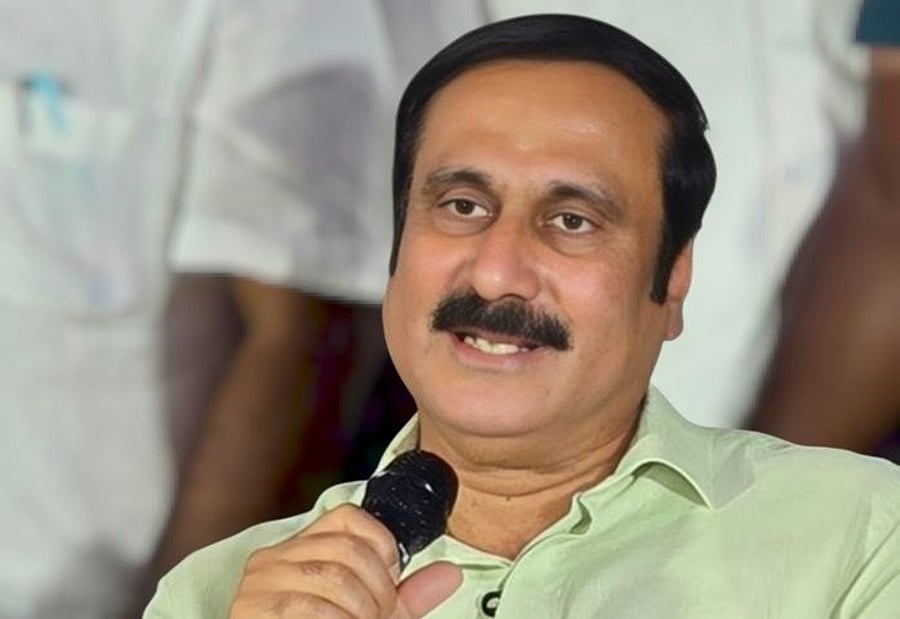
PMK leader Anbumani Ramadoss has condemned Karnataka’s attempt to create unnecessary tension by citing a non-existent Supreme Court verdict, even though court orders are clear that no new dam should be built on the Cauvery without the consent of the downstream state.
In this regard, he posted on his social media page:
Building the Mekedatu dam across the Cauvery River is Karnataka’s right; since the Supreme Court itself has already granted permission to build the dam, there is no need to seek anyone’s permission, including Tamil Nadu’s, Karnataka Chief Minister D.K. Shivakumar has said. In a situation where court orders clearly state that no new dam should be built on the Cauvery without the consent of the downstream state, Karnataka’s attempt to create unnecessary tension by citing a non-existent Supreme Court verdict is condemnable.
In response to the remarks made in the letter written by Tamil Nadu Chief Minister Vijay to Prime Minister Narendra Modi, in which he urged that the Karnataka government should not be allowed to build the Mekedatu dam without the consent of Tamil Nadu, the lower riparian state of the Cauvery, Karnataka Chief Minister D.K. Shivakumar has said this. All the information he has presented is false; it is intended to divert attention from the Mekedatu issue; and it distorts the Supreme Court’s verdict.
D.K. Shivakumar distorts the verdict
The Supreme Court has not granted any permission to the Karnataka government to build a dam across the Cauvery at Mekedatu. In the case filed on behalf of the Tamil Nadu government seeking cancellation of the permission granted to prepare a detailed project report for the Mekedatu dam, and in the review petition filed on behalf of the Tamil Nadu government against it, the Supreme Court ruled on November 13 last year and again on May 21 this year that the Cauvery Management Authority, for the Central Water Commission, would decide on granting permission for the Mekedatu dam by following the proper legal procedures; if there is no agreement with that decision, the Tamil Nadu government may approach the Supreme Court. The Supreme Court’s ruling is only that there is no need to approach it before the decision of the Cauvery Management Authority is known. This is well known to the Karnataka Chief Minister too. Yet, for political gain, he is distorting the Supreme Court’s verdict.
How can the right to build a dam be obtained?
Likewise, the Karnataka government has no inherent right to build the Mekedatu dam. Rather, the norm is that upstream irrigation areas should not implement any projects that would affect downstream irrigation areas, not only in India but across the world. This position has also been emphasized in international agreements. In the agreements signed in 1892 and 1924 between the Madras Presidency and the Mysore Presidency regarding the sharing of Cauvery waters, this is clearly stated. Given that these provisions of those agreements are valid, as clearly stated in the final award of the Cauvery Tribunal issued on February 5, 2007, and in the Supreme Court judgment of 2018, how can Karnataka have the right to build a dam?
Political motive
Uma Bharti and Gajendra Shekhawat, when they were Union Water Resources Ministers, have repeatedly stated that permission cannot be granted to the Karnataka government to build the Mekedatu dam without the written consent of Tamil Nadu, the downstream state. Knowing all this, the reason D.K. Shivakumar is taking up the Mekedatu dam issue is political.
The central government will indirectly support it
As I have already accused many times, with elections to the Karnataka Legislative Assembly due in another 15 months, Karnataka Chief Minister D.K. Shivakumar’s plan is to turn the Mekedatu dam issue into a political matter and help the Congress party win more seats in the 11 districts of Karnataka through which the Cauvery flows. For this, the Karnataka Congress government will stage all kinds of theatrics, including making a financial allocation in the Karnataka state budget to be presented next year and laying the foundation stone for the new dam. For the same political calculations, the Union government too will indirectly support all these theatrics.
It releases only floodwater
The Karnataka government has neither the legal right nor even the moral right to build the Mekedatu dam. The tribunal set up in 1990 to resolve the Cauvery dispute issued an interim award in 1991 and a final award in 2007. In the 35 years since then, not once has water been released to Tamil Nadu in accordance with either the interim award or the final award. The Karnataka government, which should regard Tamil Nadu as a legal partner in the Cauvery water-sharing arrangement, treats it as a drainage outlet and releases only floodwater.
The Supreme Court and the Central Government Should Not Believe It
Even children would not believe Karnataka’s claim that, after being forced to release floodwaters and then building a new dam to gain the capacity to store an additional 70 TMC of water, it will regularly supply water to Tamil Nadu. The Supreme Court and the Central Government should never believe this.
The Central Government Should Not Grant Permission
As elections draw nearer in Karnataka, the Karnataka government will keep unravelling falsehoods and distortions about the Mekedatu dam. The Central government should not stand by and watch even the Karnataka Chief Minister misrepresent the Supreme Court’s verdict. For this, the Central government should condemn the Karnataka government. Anbumani has insisted that the Central government should not permit the Karnataka government to build the Mekedatu dam without the consent of Tamil Nadu, the tail-end irrigation state.