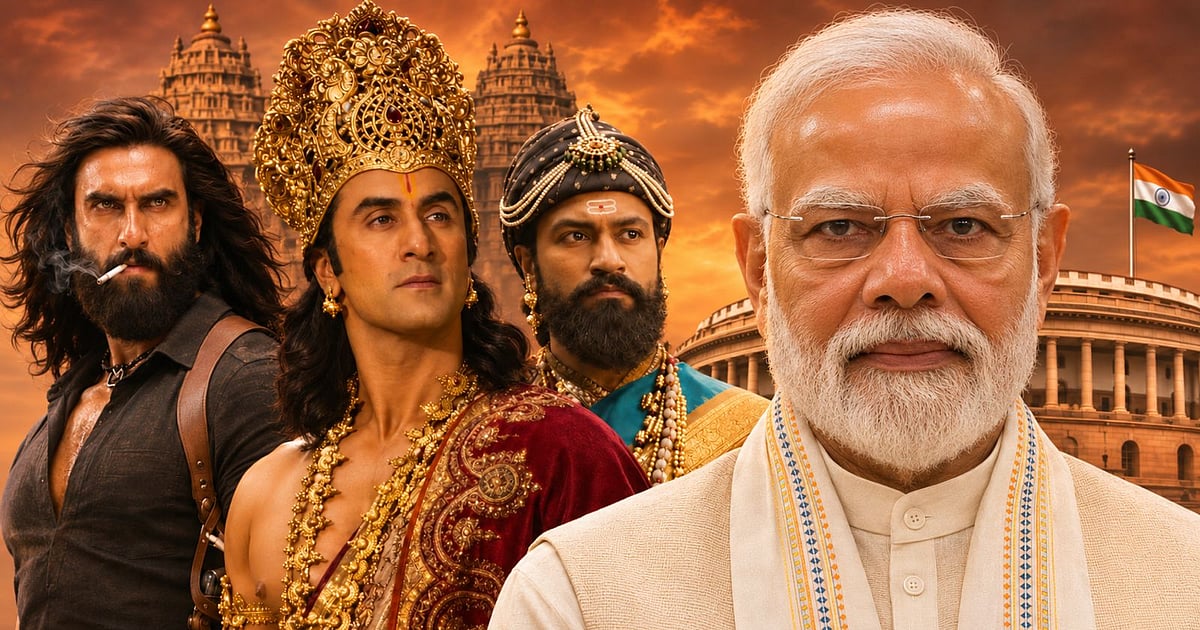
A promotional event for the film 'Ramayana,' which has been released ahead of Diwali. At the event, Ranbir Kapoor, who plays Rama in the film, said, 'Elon Musk has only now invented a flying car. But in India, there was a flying car thousands of years ago.'

It is impossible to avoid the suspicion that the intention of those who set out to make ancient epics like the Ramayana has shifted beyond merely giving people an epic experience and now serves a particular ideology off-screen. Especially in this era, when a huge number of films are being produced in support of the ruling BJP government’s majoritarian, religious right-wing politics, treating a film as just a film would be a superficial view.
BJP is a party that grew by doing politics centered on gods and temples. It is a party that grew by stirring up the feeling that the majority Hindu religion is in danger here. Just as stage plays and films were used as tools for the growth of Dravidian movements in Tamil Nadu, art forms have likewise been used across India for the growth of the BJP’s right-wing ideology. It was during the period when Hindutva organizations sharpened their focus on Babri Masjid by projecting Rama as a hero that Ramanand Sagar’s 'Ramayan' serial was first broadcast on Doordarshan.

The Rajiv Gandhi government decided to broadcast the Ramayana series on Doordarshan. Rajiv Gandhi took up the Ramayana for vote-bank political calculations. But that Ramayana serial saved the right wing the trouble. The series itself accomplished the task of carrying out massive propaganda and stirring up the emotions that had to be roused across the country. People gathered in large crowds to watch the 78-episode series, which was broadcast every Sunday morning on TV. People touched the television in reverence, garlanded the TV set, and accepted Rama as their ideal deity. Its impact was especially strong in the Hindi-speaking states. The Ramayana serial played a major role in creating public acceptance for the Ram Janmabhoomi movement and the Rath Yatra. “Through the Ramayana serial, religious sentiment entered people’s living rooms via modern technology. The right wing used this media platform, created by the secular Indian state, very effectively to build its political power,” researcher Arvind Rajagopal notes in his book Politics after Television - Hindu Nationalism - and the Reshaping of the Public in India.
Unity as Hindus, and the ideas of Hindu nationalism, were given shape very rapidly through the Ramayana serial. The chariot used in Advani’s rath yatra was similar to the chariot used in the Ramayana serial. The actors and actresses who played major roles in Ramayana stood in support of the Ram Janmabhoomi movement off-screen. “The Ramayana serial broadcast on Doordarshan proved beyond doubt how spiritually and culturally connected the people of India are. People gathering in front of the television on Sunday mornings without leaving their homes signals the rise of a new ‘cultural nationalism’ in society,” said L.K. Advani, who led the rath yatra, proudly.
The NBER (National Bureau of Economic Research), a well-known research institution based in the United States, published a research report last year that examined with data the socio-political impact of the Ramayan serial in India. According to it, in areas where the Ramayan serial had a large viewership, the way people named their children came to resemble the Ramayana. Hindu-Muslim tensions increased. The report also says that in elections too, the BJP gained lasting influence in those specific areas. Even after the late 1990s, the Ramayan serial was rebroadcast on Doordarshan many times. Like the Ramayana, the Mahabharata was also made into a serial. All of this was a factor that made it easier for the BJP to take charge on the ground. Much later, during the coronavirus period, when migrant workers were left stranded, the BJP government took pride in rebroadcasting the Ramayan on Doordarshan at that time. Along with that, they also claimed the achievement that the Ramayan serial was the most-watched television series at one time. It is against this backdrop that films based on the Ramayana in the present day must also be measured.
It is always possible to see a society’s contemporary political choices, preferences, and issues reflected in the films of that period. In a market economy, this is a commercial strategy that aligns with the mindset of the majority of people. In that sense, after the BJP came to power, especially during the period when it firmly entrenched itself for a second and then a third consecutive term, we can also see right-wing supportive films continuing to be released here.
Ramayana was not a series that the BJP aired in a planned manner. But it did what was necessary to reap its benefits. They are still following that Ramayana formula. India - The Modi Question was produced and released by the BBC as a documentary on how Modi functioned as Chief Minister during the Gujarat riots. The central government banned screenings of that documentary. Scenes from the documentary were removed from the internet wherever they could be found. The only reason was that it contained things that could embarrass the BJP government and Modi. Barely a year and a half after such a documentary was released, a film called 'The Sabarmati Report' came out. Focusing only on the Godhra train burning incident as a planned conspiracy and largely ignoring the riots that followed, Modi himself praised the film highly for aiding their narrative. All the films that Prime Minister Modi praised and reviewed—Kashmir Files, Kerala Story, Article 370—strengthened right-wing ideology. More than that, they were films that showed only half the truth, that is, they shone a light only on one side of a particular event and portrayed the other side as the villain. Films made in this way are immediately used by the BJP and Hindutva organizations for their propaganda, while also showering them with favors such as political recognition, tax exemptions, and national awards.

As a result, the core of the so-called “pan-India” films being talked about these days is rooted in spirituality and also carries right-wing political alignment. In Rajamouli’s last release, RRR, the hero Ram Charan, in the end, with no logic at all, dons saffron robes, takes on the avatar of Lord Rama, defeats the British, and saves the nation. A film called Chhaava was released last year. It is about Chhatrapati Sambhaji Maharaj, who fought against Aurangzeb and fell. The film portrays in an emotionally stirring way how Sambhaji stood firm, refusing to give up his religious identity and heritage or bow down, and how he was eventually broken by Aurangzeb’s torture.
Within a month of the film’s release and success, Hindutva groups waved flags and engaged in riots, demanding that Aurangzeb’s tomb in Khuldabad be demolished and removed. After watching Chhaava, Maharashtra Chief Minister Devendra Fadnavis praised it as a “very beautiful film,” and also said in the assembly that “the Chhaava film may have stirred up anger against Aurangzeb.” The recently released and successful film Dhurandhar too portrayed Pakistan as the villain and served to strengthen Modi’s “chowkidar” image. Films like these subtly do the work of portraying Hindu nationalism as a force that unites Hindus and the BJP and Modi as the guardians of that nation.
The 'Adipurush' starring Prabhas, which was released a year or two ago, and the recently released 'Ramayana' are all of this kind, or the BJP and Hindutva organizations claim them as their own. As elections draw nearer, even more such works may be released. These kinds of propaganda films are making an impact, however small, even in the minds of the vast majority of voters who do not have any strong allegiance, pricking them like a pin in some corner.
This Ramayana is the latest addition to the right-wing propaganda pile. The film crew has been touring the U.S. and screening it there two weeks before its release, proudly claiming that this is India’s culture and tradition. At a time when young people have turned Jantar Mantar into a fierce anti-government protest ground, the criticism, acceptance, and opposition this Ramayana film is likely to receive may even convey an important message to the nation. Because this has happened before too. The expectation is that the messages conveyed through art should be that “art should unite people; it should not divide them.”