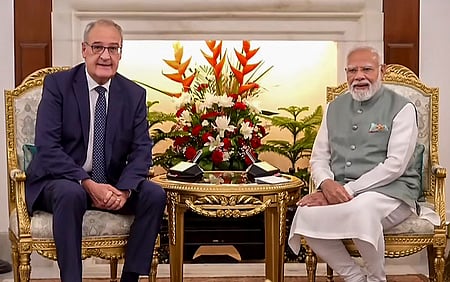
New Delhi: Swiss President Guy Parmelin met and held talks with Prime Minister Narendra Modi in Delhi on Monday. During the meeting, a decision was taken to increase bilateral trade, and five key agreements were signed between the two countries in areas including migration and public transport.
Swiss President Parmelin is in India on a three-day official visit. He has come to India for the second time, having previously participated in a conference on the impact of AI held in Delhi in February.
In Delhi, he was accorded a traditional welcome at Rashtrapati Bhavan. Later, he visited Rajghat and paid homage at the memorial of Mahatma Gandhi there. Following this, Parmelin met External Affairs Minister Jaishankar and held discussions on bilateral issues. Speaking after the meeting, Jaishankar pointed to the TEPA agreement signed in 2024 between India and the European Free Trade Association, and said that, in line with the promise made in that agreement, he greatly appreciated Parmelin’s commitment to strengthening India-Switzerland ties.
Following this, Prime Minister Modi and Swiss President Parmelin met and held talks. At that time, both discussed identifying new opportunities to strengthen India-Switzerland relations. An agreement related to migration and public transport between the two countries was signed. It was decided to increase bilateral trade.
10 lakh new jobs will be created: In this regard, the announcement issued by Prime Minister Modi states:
The India-Switzerland Trade and Economic Partnership Agreement (TEPA) has emerged as a pioneering initiative for investment, innovation, jobs, and shared prosperity between the two countries. Through this, we will achieve the goal of $100 billion in investment in India and the goal of creating more than 1 million direct jobs over the next 15 years.
Innovation, infrastructure, and modern technology are the key pillars of the India-Switzerland relationship. The two countries have decided to take their friendship forward with renewed momentum. Important decisions were made on creating greater market opportunities for Indian exporters in Switzerland and on further increasing investment between the two countries. This will help increase the volume of agricultural products, pharmaceuticals, textiles, and engineering goods exported from India to Switzerland. At the same time, our country will attract new investments from Switzerland in key sectors such as biotechnology, life sciences, banking, insurance, food processing, and sustainability.
The two countries have identified new opportunities in the existing cooperation in military exchanges and defense equipment production. They have also agreed to further increase cooperation in the nuclear energy sector. The Varanasi ropeway project, the Noida Jewar airport, railway lines in hilly regions, and tunnel projects are excellent examples of the cooperation between the two countries in the infrastructure sector.
Agreements signed: In the fields of transport and infrastructure, five agreements were signed during today’s meeting on collaboration in mobility and public transport, youth professional exchange, transport technologies, and infrastructure development. Through these agreements, numerous opportunities will be created in Switzerland for Indian students, researchers, professionals, and youth.
India and Switzerland believe in democratic values, the rule of law, and dialogue. The two countries will continue to work together for international peace and stability. Whether it is the Ukraine issue or the West Asia issue, India supports every meaningful effort made to bring about peace. Both countries have agreed that reforms are needed in international institutions in order to address the growing challenges at the global level.
AI conference in Switzerland next year: India hosted the world’s largest AI conference last February. Next year, Switzerland will host an AI conference in Geneva. Modi noted, “My best wishes to Switzerland for successfully hosting that conference.”