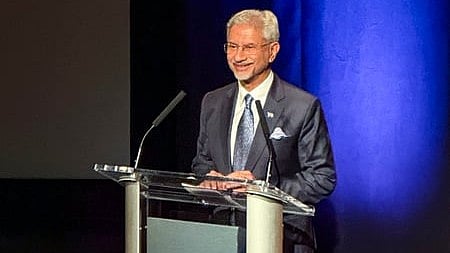
India’s External Affairs Minister S. Jaishankar said that progress has been made in India-China bilateral relations.
Jaishankar, who participated and spoke at the 81st session of the UN General Assembly last Saturday, took part on Monday in a special discussion event organized by the Asia Society in the United States.
Indian and American diaspora members and industry experts participated in it and asked him various questions about China, bilateral relations with the United States, and trade.
In response, he said: Compared with the years 2024 and 2025, there has been a manifold improvement in bilateral relations with China. This cannot be described as a structural change.
The clash that took place on the border in 2020 caused a severe rift in India-China bilateral relations. Although trade continued between the two countries, visa issuance, official exchanges, and air travel were affected.
After identifying ways to resolve the border issue, bilateral relations naturally began to improve. India had been repeatedly telling China that the ongoing conflict on the border benefits neither side.
In short, the situation prevailing along the border determines India-China relations. Therefore, we have begun to follow the basic principle that if peace is maintained along the border, bilateral relations will continue smoothly.
India-US trade agreement: The failure to finalize the trade negotiations continues to be an issue in India-US bilateral relations.
India is a country with a large number of small farmers, small manufacturers, and small industries. In contrast, the United States is a country with a large number of manufacturers. There are many differences between the societies of the two countries.
Patience is very essential to finalize a trade agreement. Its strengths and weaknesses must be examined.
We have now reached an almost complete understanding regarding the trade agreement. It is necessary to examine how the order imposing an additional 10 percent tariff on Indian goods under trade law will affect the India-U.S. bilateral trade agreement. India’s aim is to finalize the trade agreement soon and smoothen bilateral relations.
In modern times, a country’s friendship with another country cannot be determined by leaders or ministers alone. In a democratic society, people’s opinions on social media also play a major role.
Impact on India’s friendship due to US-Pakistan relations: Most countries have a complicated relationship with the United States. You say that over the past year, bilateral relations between the US and Pakistan have improved. But Pakistan, as a neighboring country, has been promoting terrorism for many years. India is one of the countries in the world affected by terrorism.
In such a situation, if our friendly nation does not recognize an issue that is important to us, I believe it will certainly affect bilateral relations, he said.
Countries moving toward multipolarity
External Affairs Minister Jaishankar said that the world has begun moving toward multipolarity.
Chinese President Xi Jinping, who visited the United States last week, met with U.S. President Donald Trump. In response to a question about this, Jaishankar said, “The world has openly begun moving toward multipolarity.
The United States stands as the world’s most powerful country and as the nation that has shaped the current global outlook. However, we see strains emerging in its relations with its allied countries because of its unilateral approach. This will have a major impact on the thinking of other countries around the world.
When the world’s second-largest economy (China) joins with the largest economy (the United States), there may be some common features between them, but the spirit of competition will not diminish. Both of these countries will place limits on the agreements they make with other countries in the world.
As a result, other countries will seek a new path to establish themselves. They will begin looking for new solutions. Because of this, we are witnessing changes taking place at the international level,” he said.