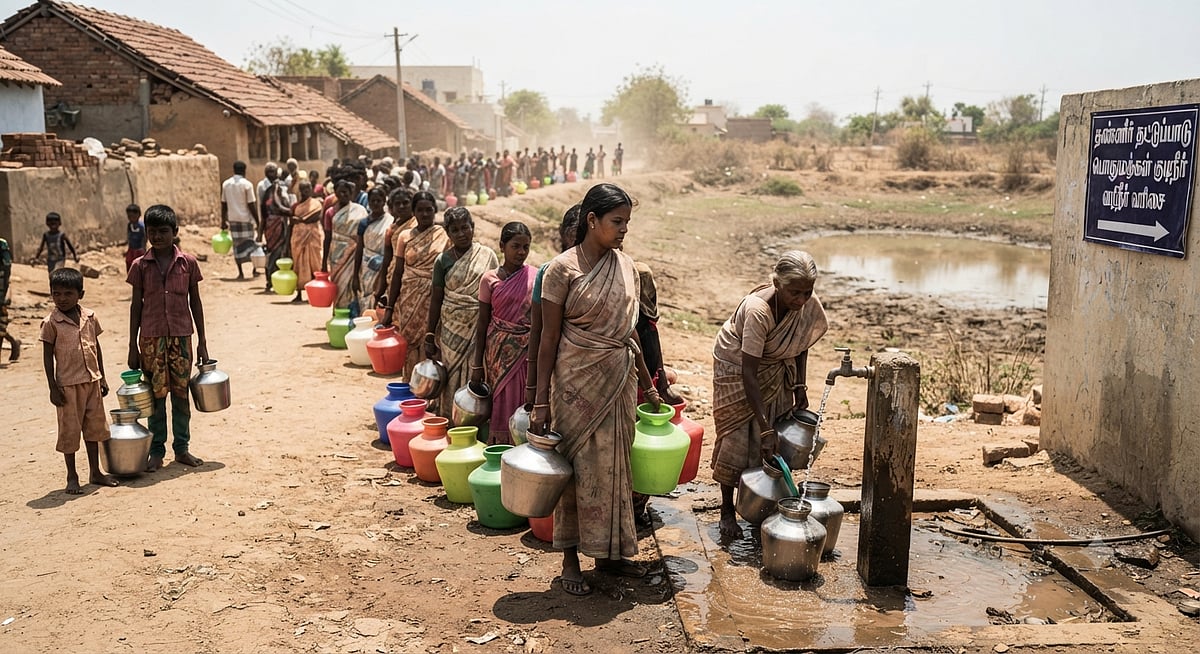
Tamil Nadu farmers who had been waiting for the northeast monsoon have, so far this year, been left disappointed. Since there has not been enough rainfall, reservoirs, lakes, and ponds, which serve as the main sources for agricultural irrigation, have not filled up completely. As a result, there is a risk of shortages for irrigation in the upcoming cropping seasons and for drinking water during the summer.
Although the southwest monsoon serves as the country’s main source of water, it is the northeast monsoon that brings Tamil Nadu the highest rainfall. This year, the southwest monsoon in Tamil Nadu was recorded at 20 percent below normal. As a result, farmers were greatly expecting the northeast monsoon. In this situation, the northeast monsoon began in Tamil Nadu on October 15. Even after a month and a half has passed, the rainfall has not been as expected. The three cyclones—Arnab, Murasu, and Akwan—that formed one after another in the Bay of Bengal all made landfall in Andhra Pradesh. As a result, the rain-bearing clouds that were supposed to move toward Tamil Nadu shifted northward, and the expected rainfall was not received in many parts of the state.
As a result, the water inflow that should reach dams and irrigation lakes through rivers and streams has decreased. Consequently, water storage in lakes, ponds, and small tanks used for agricultural irrigation has declined.
48.4 percent decline: The total capacity of the 15 major reservoirs used for agriculture and drinking water needs in Tamil Nadu is 1,98,324 million cubic feet. Of this, as of Nov. 20, only 71,793 million cubic feet (36.2 percent) of water is in storage. On the same day last year, there was 1,68,524 million cubic feet (85 percent) of water in storage. Compared with that, this year’s water storage has decreased by 96,731 million cubic feet. This is 48.8 percent lower than last year.
Tamil Nadu’s major irrigation source, the Mettur Dam, has a total capacity of 93,470 million cubic feet. As of Nov. 20, it has a water storage of 25,841 million cubic feet. Similarly, the Bhavanisagar Dam has 15,203 million cubic feet, the Vaigai Dam 2,685 million cubic feet, the Papanasam Dam 1,966 million cubic feet, and the Sathanur Dam 4,188 million cubic feet of water storage. Water storage has also declined in 15 major dams, including Amaravathi and Sholayar.
With water storage in reservoirs having declined, groundwater levels have also fallen in most districts of Tamil Nadu. According to a survey conducted in October this year, groundwater levels have decreased in 37 of Tamil Nadu’s 38 districts. Only Tirunelveli district has recorded a slight increase. As a result, not only farmers dependent on dams, lakes, and ponds, but also farmers who irrigate through wells and borewells are facing a difficult situation.
Risk to irrigation and drinking water: Regarding this, Tamil Nadu All Farmers Associations Coordination Committee chairman P.R. Pandian said:
Due to insufficient monsoon rainfall, water storage has declined in the dams that serve as Tamil Nadu’s major water sources. The irrigation lakes and ponds dependent on them have also been unable to store enough water. As a result, a situation has arisen in which it will be difficult to supply the water needed for the successive cropping seasons.
In particular, in areas where water is released from dams for irrigation, there is now an urgent need to use the available water in a planned manner.
Water shortages in reservoirs could affect not only agriculture but also urban and rural drinking water supply. In a situation where rainfall is declining, the available water must be used sparingly. During the remaining one and a half months of the northeast monsoon season, steps should be taken to fully store and use the rain that falls. If water scarcity continues, the government should advise farmers to avoid summer cultivation. Priority should also be given to desilting lakes, ponds, and other water bodies, and to work aimed at increasing their water storage capacity. The Tamil Nadu government should pay additional attention to prioritizing drinking water needs, planning irrigation water use, and properly distributing the water available in reservoirs, he said.
It is essential to use drinking water sparingly!
Due to reduced rainfall, water reserves in Chennai’s water sources are also declining. In light of this, the Managing Director of the Chennai Water Board, T. Anand, has advised the public to use drinking water sparingly.
Regarding this, he further said: The five major lakes that serve as Chennai’s drinking water sources currently have about 4.5 TMC (4,500 million cubic feet) of water in storage. Water is also being released from Veeranam Lake to meet drinking water needs. Similarly, drinking water is being supplied to Chennai through the seawater desalination plants operating in the Nemmeli and Minjur areas.
If necessary, drinking water needs can also be met through the quarry reservoirs in the Sikkarayapuram and Erumaiyur areas. As far as Chennai is concerned, there are few permanent water sources. Drinking water needs can be met to a large extent only by storing rainwater. In this situation, rainfall this year is expected to be low due to the impact of “Super El Nino.” However, it has been predicted that there is a possibility of heavy rain in the coming days.
Taking advantage of this opportunity, precautionary measures have been implemented to prevent rainwater from flowing into the sea and to store it in large quantities. In particular, steps have also been taken to ensure that rainwater is conserved through rainwater harvesting systems in homes. Therefore, considering the low rainfall and water shortage, the public should use drinking water sparingly and avoid wasting it, he said.
10 districts where groundwater levels fell the most in October
District Groundwater level decline
Tiruvannamalai 4.31 meters
Tirupattur 3.78 meters
Kallakurichi 3.12 meters
Coimbatore 2.89 meters
Ranipet 2.84 meters
Namakkal 2.74 meters
Karur 2.59 meters
Vellore 2.55 meters
Viluppuram 2.50 meters
Dharmapuri 2.48 meters