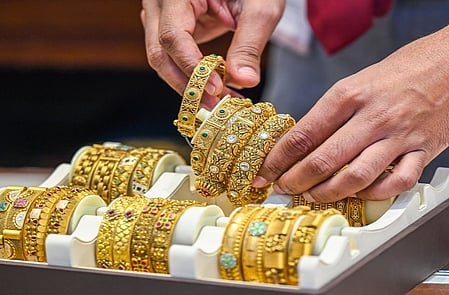
The sharp decline in gold prices has brought joy to people who had planned to buy jewelry. At the same time, it has created a major crisis for those who have taken loans by pledging gold jewelry with banks and private financial institutions.
Because the value of gold has fallen, some lending institutions are pressuring customers to pay additional money to make up the difference between the value of the pledged jewelry and the outstanding loan amount. As a result, families already facing financial hardship are living in fear that they may lose their jewelry.
Gold falls to Rs. 92,080: The price of gold, which had been steadily rising over the past few months, has now begun to move on a downward path. After gold touched an all-time high on January 29, its price has been experiencing fluctuations due to factors including changes in the international market and investors’ trading activities.
In particular, since November 10, the price of gold has been continuously declining. In this situation, on Friday (November 20) in Chennai, 22-carat jewellery gold was sold at Rs. 11,510 per gram and Rs. 92,080 per sovereign (8 grams). While on Thursday a sovereign was sold for Rs. 95,840, the price of gold fell by Rs. 3,760 in a single day.
Joy and distress... As the price of gold has fallen, families planning to buy jewelry for weddings and other auspicious occasions have been delighted. However, this same price drop has become a major burden for those who took loans by pledging jewelry. Since there is a difference between the value of the jewelry calculated when the loan was given and its current value, some companies are pressuring customers to pay the additional amount. As a result, they are now faced with the situation of having to pay extra money to continue the loan or pledge additional jewelry.
Why does a loan crunch happen if the value of gold falls?: Generally, loans are provided up to a certain percentage of the value of gold jewelry. When granting a loan, the weight of the jewelry, the purity of the gold, and the market price on that day are taken into account. If the price of gold keeps rising, the value of the collateral increases for the institutions that issued the loan. But when the price suddenly falls, the market value of the jewelry pledged as collateral also decreases.
This changes the ratio between the outstanding loan amount and the current value of the pledged gold jewelry. To deal with this, some lending institutions advise customers to pay an additional amount or reduce the loan amount. Such measures vary depending on the terms of the loan agreement and the institution’s lending policy.
Regarding this, a bank manager said that loans are provided up to a maximum of 75 percent of the value of the pledged jewelry. Since gold prices are currently falling, borrowers are being advised to pay the interest installment amount. He said that if they do not pay the amount, their jewelry will be auctioned after three months.
Regarding this issue, investment advisor Rajesh Narayanan said that when gold was at a peak of up to Rs. 16,000 per gram in January last year, loans were available from banks up to Rs. 12,000. Currently, since the value of gold has fallen by about 35 percent, private gold loan companies are sending notices asking for loan installments and interest, he said.
12-month loan tenure: Some gold jewelry loans are short-term loans that must be repaid within 12 months. In particular, the Reserve Bank has set a 12-month upper limit for certain consumer loans in which both the interest and principal are paid in a single installment at maturity. As a result, those nearing the end of the loan period are forced to repay the principal and interest to redeem their jewelry. When borrowing again by pledging the same jewelry, the loan amount is calculated based on the current gold price, so the loan received is lower than the amount obtained earlier. This has also created a situation where additional money is needed even to settle the old loan.
Proper notice is required before auctioning jewelry: the jewelry of those who have not paid their loan installments cannot be auctioned immediately. According to Reserve Bank guidelines, sufficient notice must be given to repay the outstanding loan and redeem the jewelry. In addition, the auction process must be transparent. The auction notice must be published in at least one regional-language newspaper and one national newspaper. After adjusting the outstanding loan amount from the proceeds of the auction, the remaining amount must be given to the customer.
After the loan has been fully repaid, the pledged jewelry must be returned within a maximum of 7 working days. The Reserve Bank has also stated that if there is a delay due to the fault of the lending institution, compensation of Rs. 5,000 must be paid for each day.
Will the price of gold fall further?: Gold traders say that the price of gold may see a further decline in November, and that in December there is a possibility of prices rising again depending on the U.S. Federal Reserve’s interest rate decision. It is also being suggested that this could be an opportunity for long-term investment. However, it is difficult to predict with certainty how much the price of gold will rise or fall.
While the drop in gold prices brings joy to those buying at jewelry stores, it also brings tears to families struggling to redeem pledged ornaments. Amid the fluctuations in gold prices, protecting the savings of ordinary people’s families has become an urgent need today.
Price of ornamental gold in Chennai - one sovereign (8 grams)
Nov. 10 Rs.1,05,680
Nov. 11 Rs.1,04,120
Nov. 12 Rs.1,02,520
Nov. 13 Rs.1,01,560
Nov. 14 Rs.1,00,920
Nov. 15 Rs.1,00,920
Nov. 16 Rs.1,00,320
Nov. 17 Rs.99,760
Nov. 18 Rs.97,720
Nov. 19 Rs.95,840
Nov. 20 Rs.92,080.