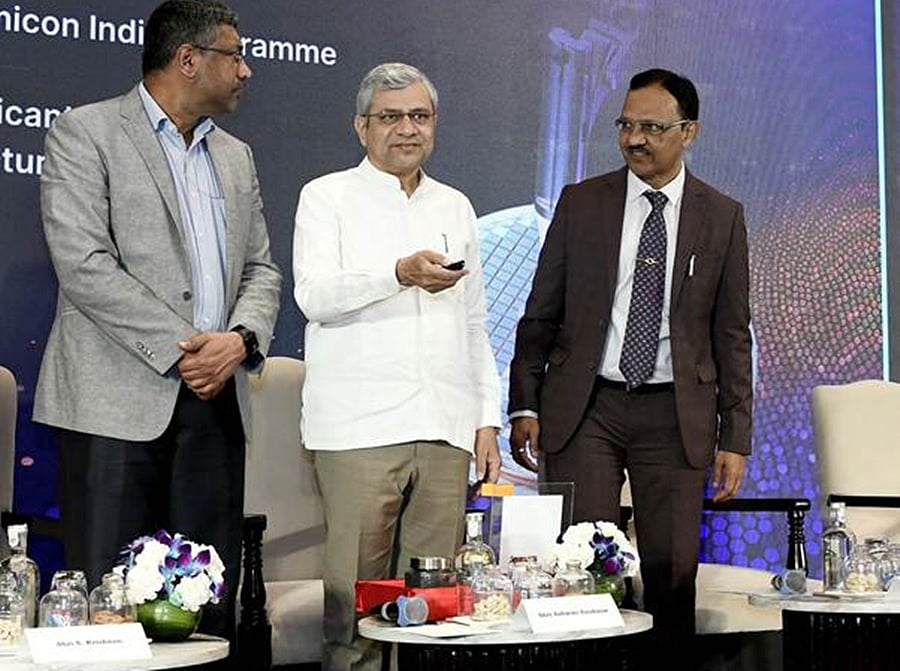
Union Minister for Railways, Electronics and Information Technology Ashwini Vaishnaw said that the central government's goal is to make India a global electronics and semiconductor manufacturing hub.
Ashwini Vaishnaw launched the online application portal for the 'Semicon India 2.0' scheme.
He then said:
The country’s electronics manufacturing sector is moving beyond merely assembling components and is evolving into a complete domestic manufacturing chain that includes parts, raw materials, and advanced technologies. This reflects the transformation in the electronics sector over the past 10 years and shows the success of the joint efforts undertaken by the government and industry, he said.
Through various strategic initiatives and policy interventions, the Central Government has been making concerted efforts to build a strong and resilient semiconductor ecosystem in the country.
He said that production capacity for battery cells, circuit boards, and related items is increasing, and that government schemes are strengthening the domestic supply chain while creating new opportunities for micro, small, and medium enterprises. About 50% of the approved units under this scheme belong to the micro, small and medium industries sector. He also said that the 'Semicon India 2.0' scheme will focus especially on building a strong semiconductor ecosystem centered on equipment, raw materials, and chemicals, and that the target is to attract at least three major equipment manufacturers and five chemical and gas companies to India for this purpose.
He emphasized that great care must be taken in selecting projects, and Ashwini Vaishnaw stressed that, in line with the vision of a 'self-reliant India,' importance should be given to quality, modern technology, research, and international competitiveness.
He also said that the central government has set a target of transforming India into a globally competitive electronics and semiconductor manufacturing hub, and that India is focusing on becoming the capital of the world’s AI applications. He called on industry stakeholders to work together, share expertise, and move toward continuous improvement.
Under the electronics components manufacturing scheme, projects from 12 new companies were approved today. For this, an investment of Rs. 7,503 crore will be made, and goods worth Rs. 39,045 crore will be manufactured. This is expected to create direct employment for 7,127 people.
The approved projects are to be implemented in 7 states, including Tamil Nadu. So far, approval has been granted for 118 projects in 16 states to manufacture 34 types of products. The total investment for these is Rs. 77,051 crore. Through this, import dependence will decrease and domestic manufacturing will be strengthened, Ashwini Vaishnaw said.