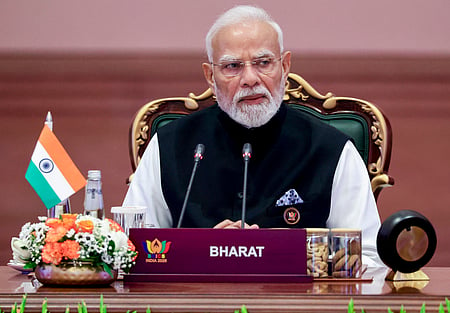
Prime Minister Narendra Modi emphasized at the BRICS summit that began in Delhi on Saturday that global governance reforms are the need of the hour.
He also proposed that countries of the Global South should move from being “rule followers” to becoming “rule makers,” and that an “emergency support framework” should be created under the BRICS grouping for the safety of seafarers facing threats from global problems.
The Prime Minister’s remarks have drawn attention, as 10 Indian seafarers have so far lost their lives due to the West Asian war.
BRICS summit begins: India is chairing the BRICS grouping this year, which includes 11 countries—Brazil, Russia, India, China, South Africa, Egypt, Ethiopia, Iran, the United Arab Emirates, Saudi Arabia, and Indonesia. Belarus, Bolivia, Kazakhstan, Cuba, Malaysia, Nigeria, Thailand, Uganda, Uzbekistan, and Vietnam are BRICS partner countries.
The two-day BRICS summit, hosted by India, began on Saturday at Bharat Mandapam in Delhi. The conference has gained significance amid the impact on the global economy caused by the Russia-Ukraine war, the West Asia issue, and U.S. President Donald Trump’s trade policy and tariff impositions.
Participation of international leaders: At the BRICS summit, Russian President Vladimir Putin, Chinese President Xi Jinping, Iranian President Masoud Pezeshkian, South African President Cyril Ramaphosa, Malaysian Prime Minister Anwar Ibrahim, Indonesian President Prabowo Subianto, Abu Dhabi Crown Prince Mohammed bin Zayed Al Nahyan, Ethiopian Prime Minister Abiy Ahmed Ali, Egyptian President Abdel Fattah el-Sisi, Vietnamese Prime Minister Li Minh Hung, UN Secretary-General Antonio Guterres, World Health Organization Director-General Tedros Adhanom Ghebreyesus, New Development Bank (NDB) President Dilma Rousseff, Asian Infrastructure Investment Bank President Zou Jiayi, and others participated along with Prime Minister Modi.
Not against anyone: In his opening session speech, Prime Minister Modi said: Since this year marks the 20th anniversary of the BRICS grouping, the current summit is a historic milestone. In human life, the age of 20 marks entry into a new phase of maturity and responsibility. Accordingly, the BRICS grouping has also reached a moment of maturity. This is not an organization against any country.
As BRICS has emerged as an important global grouping, it must formulate a new, ambitious action plan for the next 20 years. Through this, global challenges can be addressed effectively.
With the primary objective of protecting developing countries from the economic impacts of the wars in Ukraine and West Asia, India has positioned the Global South as a central part of its agenda by seeking effective solutions to safeguard food, energy, and supply chains.
10-point action plan: The BRICS countries should jointly formulate a 10-point action plan for global governance reform by the next summit. The plan should be based on three key pillars: representation, accountability, and rule-making.
UN Security Council reforms should not be delayed any further. In international financial institutions, voting rights, leadership positions, and policy priorities should be aligned with current economic realities. It is important that countries that are the driving force behind global economic growth play an appropriate role in shaping global economic governance.
Safety of seafarers: Seafarers play a major role in global trade. Therefore, their safety must be given top priority. During difficult times, they do not receive adequate support. To address this problem, an emergency support framework for seafarers should be created. Through this, maritime authorities and embassies should be coordinated to provide seafarers with assistance such as emergency alerts, medical aid, information for families, and rescue operations. He said that the unity and consensus prevailing in the BRICS alliance should be transformed into firm solutions on the world stage.
Since the West Asian war began last February, attacks on ships in the Strait of Hormuz region have been continuing. It is noteworthy that 10 of the 16 Indians who lost their lives in this war were sailors.
‘Power Pyramid - Cooperative Plateau’
‘The world’s current system of governance is like a pyramid. That is, power and the right to make decisions are concentrated at the top of the pyramid. Countries at the top make decisions that affect countries at the lower levels. At the same time, lower-tier countries do not have the authority to set rules.
In today’s world, the Global South, which is at the forefront of being affected by crises, is at the back of the line when it comes to decision-making power. We must transform this ‘pyramid of privileges’ into a cooperative level playing field. Representation and participation appropriate to all countries must be ensured,” Prime Minister Modi emphasized at the BRICS summit.