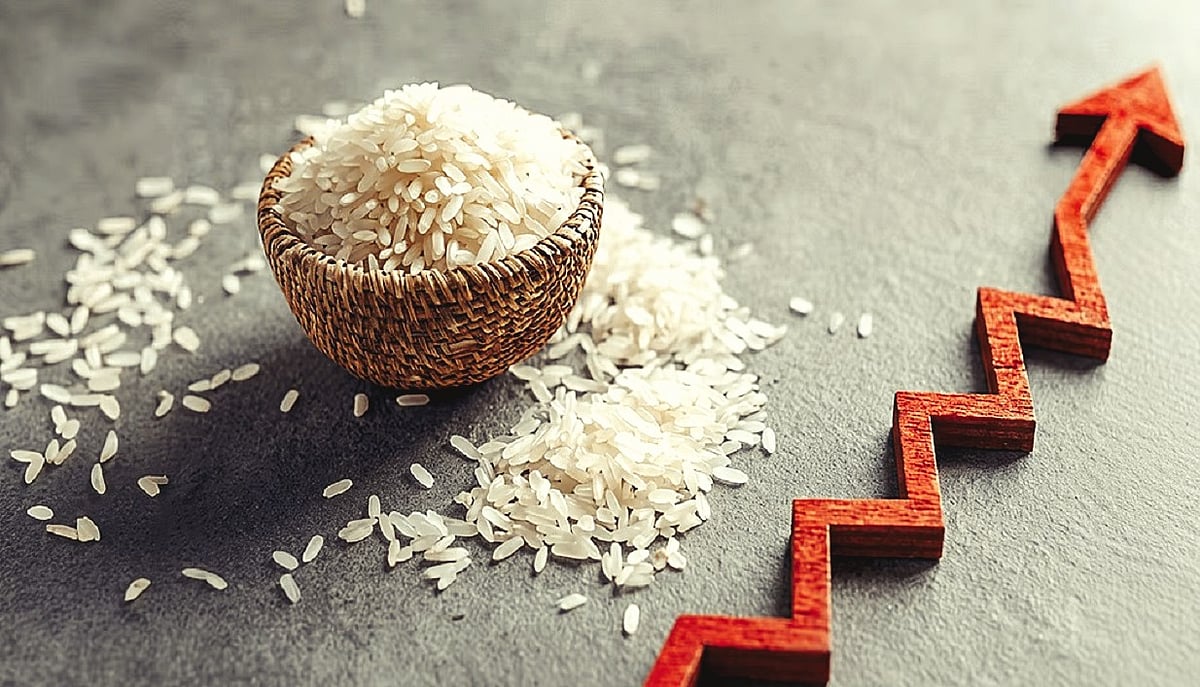
A country’s economic growth is not reflected in stock market figures; it is reflected in the food on ordinary people’s plates. The rise in rice prices by Rs. 10 to Rs. 20 per kilo, without much noise, has completely turned the monthly income-and-expense calculations of the middle class upside down.
Rice, which stands as a symbol of Indian kitchens and the staple food of the people of South India, is now becoming out of reach for ordinary people. Although many reasons are cited, from failed monsoons to reduced market arrivals, it is the people at the bottom who are bearing the direct impact.
Ordinary people who once thought twice before buying luxury goods are now being forced to think twice before buying even a sack of rice. Climate fluctuations and speculative trading have intensified the hunger in the stomachs of the poor.
Over the past few months, it has become necessary to spend an additional Rs. 300 to Rs. 500 for a 26 kg sack of rice. As a result, ordinary rice has risen to Rs. 70 per kg at retail, and a 26 kg sack now costs Rs. 1,800. The price of premium rice has increased to Rs. 82 per kg, pushing a sack up to Rs. 2,150.
What has changed in agriculture?
Paddy cultivation depends entirely on the monsoon and irrigation. The changing conditions brought about by climate change have severely affected rice production.
Across the country, the area under paddy cultivation in the Kharif season has decreased from 449.18 lakh hectares to 433.62 lakh hectares. The Union Agriculture Ministry says there has been a 3.46% decline in the area under paddy cultivation.
The impact of “El Niño” is also a major reason for this decline. In Andhra Pradesh, Telangana, Karnataka, Maharashtra, and Tamil Nadu, the failure of the monsoon reduced the area under cultivation. As the water level in rivers and reservoirs fell, farming became possible only by relying on borewells, which also increased production costs.
That is why the Central Government has advised state governments to guide farmers toward shifting to crops that require less water, such as short-duration crops, pulses, and millets. Union Agriculture Minister Shivraj Singh Chouhan has noted that “changing crop cultivation strategy is a necessity of the times.”
Monsoon - Market Situation
The southwest monsoon was recorded at 12.6% to 13% below the long-term average. According to the Meteorological Department, deficient rainfall was recorded across 42% of the area.
The minimum support price fixed by the central government is Rs. 2,440 per quintal. However, in the open market, the price of paddy has increased to Rs. 4,000. Over the past month, rice prices have risen by 5.59%. Compared with last year, they have increased by 52.4%.
Main reasons:
Supply shortage: The inflow of paddy and rice from Andhra Pradesh, Telangana, Karnataka, and West Bengal to consumer states like Tamil Nadu has decreased significantly.
Rising production costs: As the prices of fertilizer, diesel, pesticides, and farm labor have increased, the market price of paddy has naturally risen as well.
Low stock levels: Since mill owners do not have sufficient paddy stocks, supply is lower than market demand.
Festival-season demand: The increase in consumer demand for rice during Diwali and the subsequent festive season is also a major reason for the price rise.
What are the prices of each variety?
> Deluxe Ponni: 26 kg bag increased from Rs. 1,400 to Rs. 1,800
> Ponni rice: 26 kg bag increased from Rs. 1,600 to Rs. 1,950
> White Ponni increased to Rs. 2,300
> Idli rice: 26 kg bag increased from Rs. 900 to Rs. 1,200
> Basmati rice: 30 kg bag increased from Rs. 3,300 to Rs. 3,600
What next?
Due to the Diwali festival and the delay in the arrival of the new harvest, the price rise may continue for the next one or two months. After January and February, when the new paddy harvest begins to arrive, prices will gradually come down. If necessary, the government will take measures to control prices through open market sales and export restrictions.