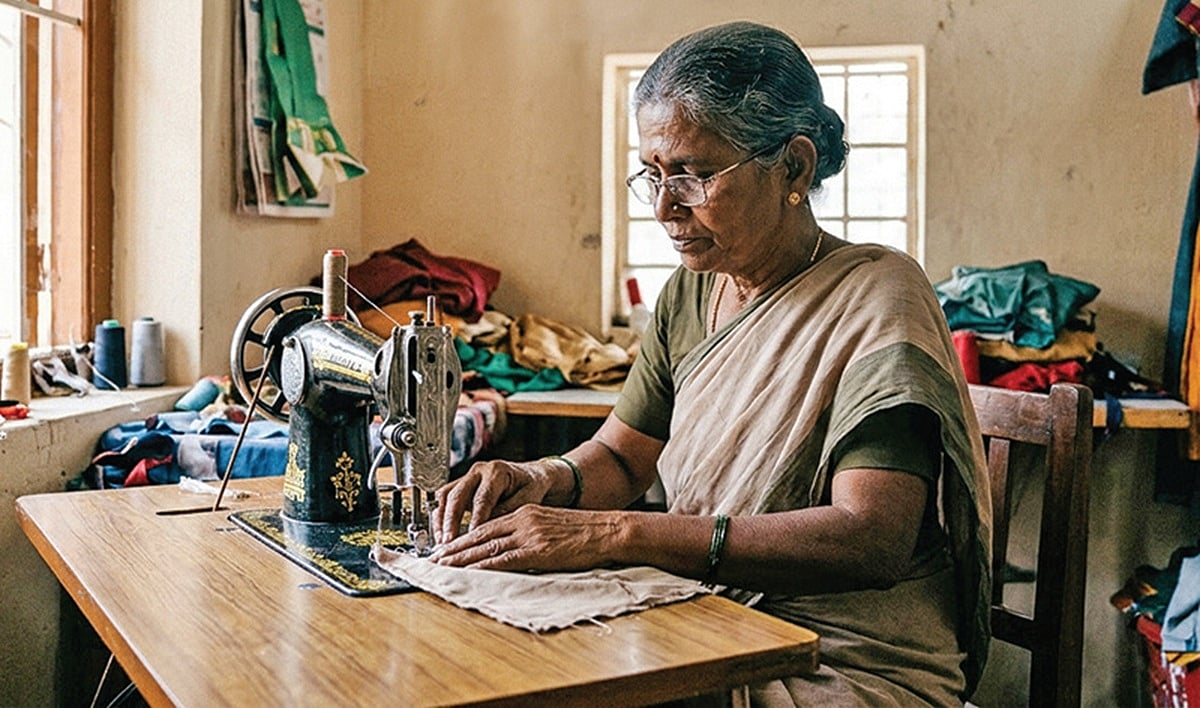
My aunt, Kaliammal, was a woman who overcame the hardships she faced without a male companion and lived a dignified life. Her self-respect, courage, and hard work, which made that possible, guide us to live every moment of life meaningfully, with love and hope.
He completed his primary education in the village of Pothanur Konavaykkal Palayam, where he was born. The middle school was in Nanjundapuram. The only way to reach the school was a narrow path surrounded by deserted burial grounds. Afraid to take that route, the students in that village stopped with their primary education, but he continued along that path with just one friend and completed eighth grade. Later, he went to a high school in another town and studied there. After getting married and before the early childhood of her two children had passed, her husband died, and her happiness faded.
Although she lived by doing whatever small jobs she could get, she did not want to live dependent on her siblings. In those days, when there were no private hospitals, her aunt got a job at the government hospital in Mettupalayam. Since it was a low-level job, leave was very rare. She had to work hard for 16 hours. Even so, she loved that job, which moved her from dependence toward self-reliance. Since there were no relatives nearby, she would take the children with her until they were enrolled in school.
On the tree near the postmortem room, she untied the knot of superstitions and tied a cradle for her child; it was a cradle that rocked the generations of knowledge. In her 37 years of work experience, she was promoted to the post of junior assistant and retired. After that, she received tailoring training and has been doing tailoring work that does not require much skill.
In decisions regarding her sons’ education and marriage, she decided based on their wishes. She did not impose any conditions on the bride’s family, including dowry. During my pregnancy and childbirth, her contribution and care, going beyond customs and traditions, were immense.
What impressed me was the severity he showed toward those who lamented to me, “It’s turned out to be a second girl too,” and the kindness he showed toward girl children. No matter how powerful a person was, he would make his opposition felt if they acted against righteousness.
He said he wanted to see the school he had studied at and the schoolmate who had traveled with him. When we traveled along the same route as a family and reached the school, he became emotional and said, “This school is what gave me life.” We met the friend who had walked with him. She told us, “In this village, where even the boys did not study beyond the tenth grade, Kaliamma was the first to go on to twelfth grade, so they honored her by praising her and giving her a prize on the village stage,” and that one sentence carried the impact of a hundred emotions for us. If one is a woman, she should be like my aunt!
- Yasodha Saravanan, Chennai.