Union Home Minister Amit Shah has proudly said that the separatist sentiments among Kashmiri youth have been put to an end by the abrogation of Article 370, the special constitutional provision.
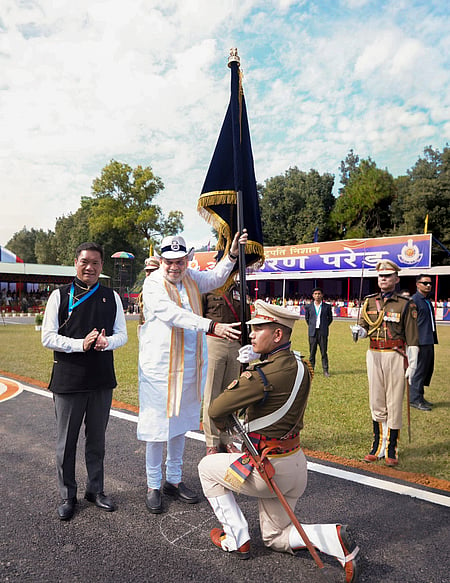
A ceremony to present the President’s Medal and banner to police personnel was held on Saturday at the police training center in Bandardeva near Itanagar in Arunachal Pradesh. Union Home Minister Amit Shah attended the event and spoke as follows:
In Kashmir, the 1990s were marked by tension due to incidents of violence and terrorist attacks. The reason for this was the separatist sentiments prevailing among Kashmiri youth. However, by revoking Article 370, which granted special status to Jammu and Kashmir, in 2019, the Central government put an end to those separatist sentiments.
Not only that, but now, after 35 years, not even a single young person in Kashmir is involved in any terrorist incident. With the revocation of the special status, a huge change has taken place in Kashmir.
The change that has taken place in Kashmir is not due only to the killing of terrorists. It is also because the discrimination seen among the youth there has been ended, and the sense of alienation has been put to rest.
Development works have been continuously undertaken in Kashmir since 2014 by the Central government led by Prime Minister Modi. As a result, the prospects for lasting peace there have been strengthened.
This change in Kashmir is something that brings pride to the entire nation. It reflects the sacrifices and dedication of our security forces and intelligence personnel. He said that the coming years will be capable of bringing great hope and development to Kashmir.
Chief Minister Pema Khandu and others participated in the event.
Siang hydropower project issue: The central government is set to establish a hydropower plant on the Siang River flowing through Arunachal Pradesh. It is planned to generate 11,200 megawatts of electricity through it. However, people in the Siang valley region have been expressing concern that this project will affect their livelihoods. Speaking about this, Amit Shah said, “The concerns of the people of the Siang region will be addressed through dialogue. When this project is implemented, the culture, traditions, and religious beliefs of the area will not be affected in any way,” he said.
The Siang River first enters India’s Arunachal state through the Tibet region under China’s control. While flowing in China, the river is also known as the Yarlung Tsangpo; in Arunachal Pradesh it is called the Siang River, and in Assam it is known as the Brahmaputra River. China is planning to build a massive hydropower station on this river in the area under its control. Similarly, India is also set to build the Siang hydropower station in Arunachal Pradesh.