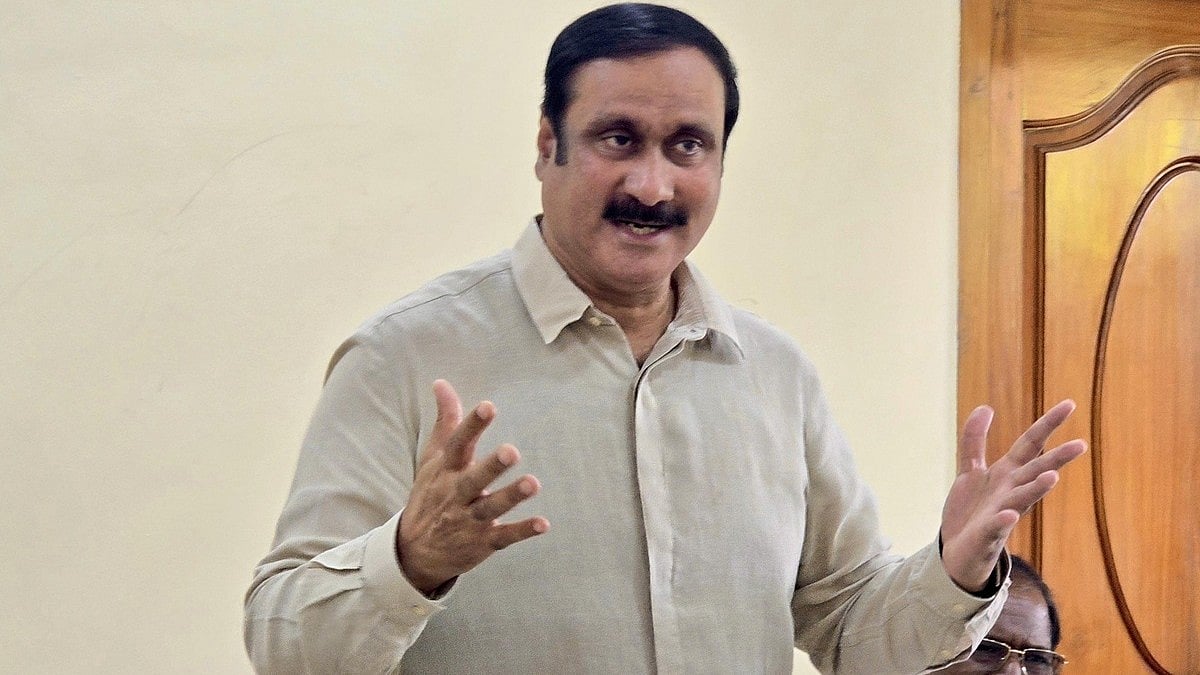
Chennai: “To tackle the power shortage in Tamil Nadu, buying 4,500 megawatts of electricity at a price of Rs. 35 per unit will result in losses exceeding Rs. 1 lakh crore, causing the Electricity Board to become unable to function and grind to a halt, or else forcing a twofold increase in electricity tariffs,” warned PMK leader Anbumani.
In a statement he issued on this, he said, “It is shocking that the Electricity Board has entered into an agreement with private companies to buy 4,500 megawatts of electricity at an average price of Rs. 35 per unit to tackle the power shortage in Tamil Nadu. In the current situation, although there is no choice but to buy electricity at a high price, if this situation continues, it will not be possible to manage the crisis, so alternative arrangements should be explored.
With unscheduled power cuts having been in effect in Tamil Nadu for more than the past month, the Tamil Nadu Electricity Board has decided to buy electricity from the open market to cope with it.
Accordingly, the Electricity Board, which had invited bids to purchase 4,500 megawatts of power, has entered into an agreement with private power companies that had submitted bids to buy electricity at prices ranging from Rs. 31.99 to Rs. 37 per unit, that is, at an average price of Rs. 35 per unit. This price is the highest ever.
If it had tried a few weeks earlier, it could have bought electricity at a lower price than this. However, with the demand for electricity rising across the country to an uncontrollable level, it is said that the Electricity Board has no choice but to buy power at a higher price.
Although this is only a temporary arrangement, if this situation continues for several more months, the loss the Electricity Board will face is likely to be unimaginable. One megawatt of electricity can be used to consume 1,000 units of electricity in one hour. Accordingly, 4,500 megawatts of electricity can be used to consume 45 lakh units of electricity in one hour, and 10.80 crore units of electricity in 24 hours in a day.
The Electricity Board sells one unit of electricity to homes and businesses at an average price of only Rs. 7. If the subsidy and compensation for free electricity provided by the Tamil Nadu government, amounting to about Rs. 32,000 crore a year, are also included, the Electricity Board receives only Rs. 10.32 per unit of electricity. If one unit of electricity is bought for Rs. 35 and sold for Rs. 10.32, a loss of Rs. 24.68 is incurred. For 10.80 crore units a day, this results in a loss of Rs. 266.54 crore. Annually, this results in a loss of Rs. 97,288.56 crore.
This is only the loss caused by the additional electricity purchased now. Moreover, if we also take into account the 15% electricity loss and the loss caused by electricity purchased from other sources, the total loss will exceed Rs. 1.20 lakh crore.
The Electricity Board is already struggling under a debt of Rs. 2.47 lakh crore. The electricity board pays more than Rs. 10,000 crore a year just as interest on the loans it has taken. In addition, if the loss of more than Rs. 1 lakh crore caused by purchasing 4,500 MW of electricity at a high price is also added, the Tamil Nadu Electricity Board will be unable to function even for another year and will either grind to a halt or be forced to double electricity tariffs. Neither of these is good for the Tamil Nadu Electricity Board or for the people of Tamil Nadu.
The reason Tamil Nadu is facing such a crisis is that the thermal power projects announced by the Tamil Nadu Electricity Board were not completed on time. While Tamil Nadu’s average power demand is 22,000 megawatts, the amount of electricity generated yesterday by the Tamil Nadu Electricity Board through its own thermal power stations was only 3,216 megawatts.
In Tamil Nadu, over the past 20 years, only 2,900 megawatts worth of thermal power projects have been implemented. In the past decade, only the 800-megawatt North Chennai Stage III Thermal Power Station began commercial power generation, and that too only in January this year.
The work on the 1,320 MW Udangudi thermal power plant, whose foundation stone was laid a decade ago, has been completed only up to 95%, and the work to set up the 1,320 MW Ennore Special Economic Zone thermal power plant has been completed only up to 75%. The work to set up the 1,600 MW thermal power plant at Uppur has been left pending after 35% completion. The 660 MW Ennore thermal power plant expansion project remains stalled without any progress.
In addition to these, thermal power projects with a capacity of more than 12,000 megawatts have also been announced and are still only at the notification stage. Among them, only some basic work has been carried out in name for the two 1,320-megawatt thermal power projects at Udangudi and the 600-megawatt thermal power project in Thoothukudi district. Apart from these, no constructive steps have been taken to implement the remaining thermal power projects.
Tamil Nadu’s electricity demand is estimated to increase by at least 12% to 15% every year. In such a situation, if domestic power generation capacity is not increased, electricity will have to be purchased at similarly high prices.
Recognizing this, the 4,900 MW thermal power projects in Tamil Nadu that have been laid but not completed, as well as the 3,240 MW thermal power projects that have been announced but on which no work has yet begun, must be completed on a war footing.
He has emphasized that the Electricity Board should immediately release a timeline on the implementation progress of these projects so that people can know the progress of these power projects and when they will be completed.