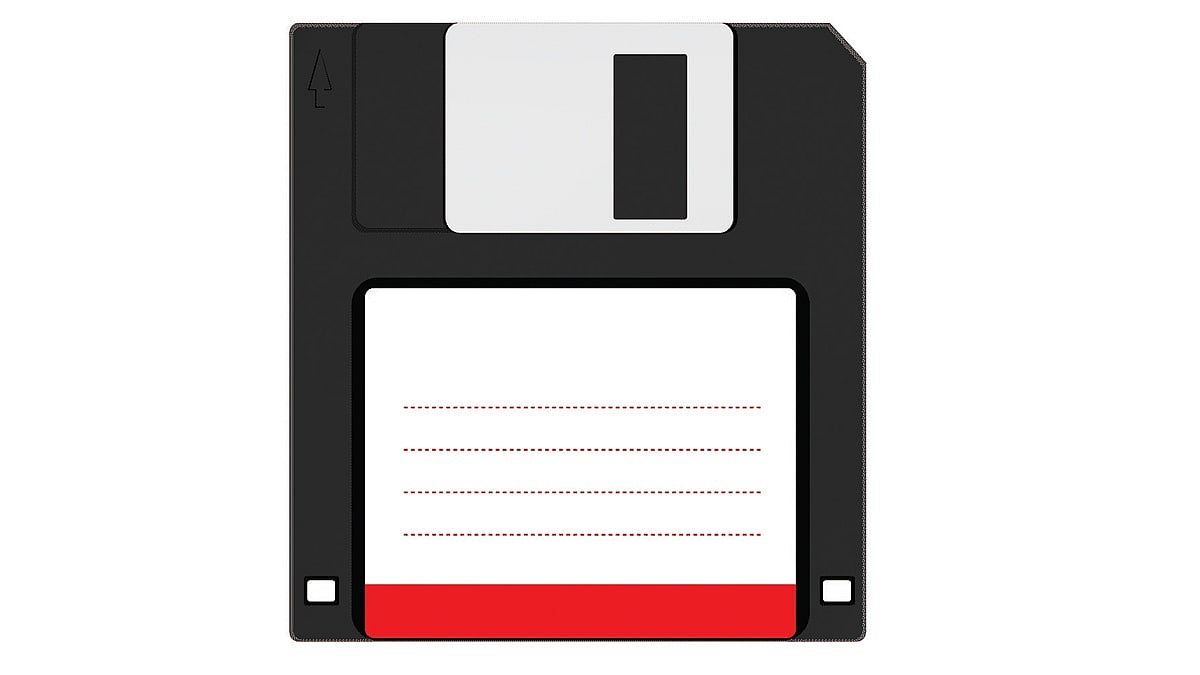
Behind the moments when people were met with the words, “I know what a copy is, but what’s a floppy?”, there lurks the question, “So how old are you now?”
For today’s AI generation, it may seem strange that the previous generation used everything related to computers, including the “floppy,” with such reverence.
In the 2000s, many people thought a thousand times before even touching a computer keyboard. Such people handled the “floppy,” which made it possible to save their files, as carefully as they would a flower.
When you push the floppy, called a “flexible disk,” into the small “floppy drive,” it brings to mind all those times a cassette got stuck in a VCR.
If the floppy’s contents do not appear on the screen even after a few minutes, one can become anxious. At the same time, there is also fear of immediately pressing the “Eject” button and removing it (the thought of “what if it crashes” is still common today).
Floppies usually contain only Notepad or WordPad files, low-quality images, and the like; after all, its total capacity is only 1.44 MB. Opening them on the computer and doing “copy & paste” would itself be a major struggle.
Among the mostly black floppies, the ones in bright, flashy colors would stir envy. Once it was understood that all of that was just a superficial coating, its charm had already faded away.
If you slide the aluminum plate on the top, there is something like a “film” inside. If you break open the floppy and look inside, it appears as though a thick plastic sheet is circularly arranged around the button in the center.
All the information is stored there. Within just a few years, in the “competition” brought about by CDs and DVDs, the place for the “floppy drive” was taken away.
Even though many options like pen drives, external hard drives, and cloud storage have since come along, the traces of the “floppy” remain undimmed among those who fell in love with computers in the 2000s.
The journey of the “floppy”
The “floppy” was commercially introduced by IBM in 1971. It was designed by a team led by Alan Shugart.
It was 8 inches in size and could handle roughly 100 kilobytes of data.
In 1976, 5 1/4-inch floppies were designed. In the eighties, 3.5-inch floppies were used. In 2011, Sony announced that production of it would be discontinued.
Even today, ‘floppy’ disks are used for data storage in Boeing 747–400 aircraft.
The reason is that the cost of replacing them with modern technology runs into crores. Even in hospitals with old CDs and ultrasound equipment, in music studios that handle old music collections, and in some countries for computers related to security systems, ‘floppy’ disks are still used.