Three bills—The Constitutional Amendment Bill 2026, the Delimitation Bill 2026, and the Union Territories Laws Amendment Bill 2026—were introduced in the Lok Sabha last April to implement the 33 percent reservation for women.
These bills had planned to increase the number of Lok Sabha constituencies from 543 to 850. Since they are constitutional amendment bills, they require the support of two-thirds of MPs to be passed. However, the bills could not be passed due to insufficient support.
In this context, it has been announced that the special session of Parliament will begin on November 30 and continue until December 3. It is expected that bills related to the implementation of women’s reservation and the delimitation of Lok Sabha constituencies will be introduced in it.
To confirm this, a meeting of the Union Cabinet was held in Delhi on Friday under the leadership of Prime Minister Narendra Modi. In it, approval was given to increase the number of Lok Sabha constituencies by 50 percent, equally for all states. This decision has increased support for the BJP government.
Regarding this, central government sources said, “Based on the population of 1971, there are currently 543 seats in the Lok Sabha of Parliament. Following this, it had been planned to increase the number of Lok Sabha constituencies to 850 on the basis of the 2011 population census. The southern states strongly objected to this.
Population growth has been controlled in all southern states. Therefore, it was pointed out that if the number of constituencies is increased on the basis of population, the southern states will be affected.
For this, Union Home Minister Amit Shah had already given a clear explanation during the special session of Parliament last April. He assured that the number of seats would be increased by 50 percent uniformly for all states.
Based on this, the bill has now been amended, and the Union Cabinet has approved increasing Lok Sabha constituencies in all states by 50 percent.
Accordingly, the number of parliamentary Lok Sabha constituencies will increase to 815. Of these, 33 percent of the seats will be reserved for women. There will be no change in the number of Lok Sabha constituencies until the year 2051.
Tamil Nadu currently has 39 Lok Sabha constituencies. Based on a 50 percent increase, the number of Lok Sabha constituencies in Tamil Nadu is expected to rise to 59.
It is noteworthy that the number of Lok Sabha constituencies is expected to increase from 80 to 120 in Uttar Pradesh, from 48 to 72 in Maharashtra, from 42 to 63 in West Bengal, and from 40 to 60 in Bihar.
After the bill is passed in Parliament, a delimitation commission will be constituted. This commission will redraw the Lok Sabha constituencies across the country. Central government sources have said that general elections will be held for all 815 Lok Sabha constituencies in 2029.
As of last April, the BJP alliance had 292 MPs in the Lok Sabha. After the West Bengal Assembly election, the Trinamool Congress split. Twenty Lok Sabha MPs from that party have joined the Nationalist Citizens Party and are supporting the BJP.
6 MPs from Uddhav Thackeray’s Shiv Sena joined the Shiv Sena led by Eknath Shinde. As a result, the strength of the BJP alliance increased to 318.
The BJP won the by-election held in Assam’s Nagaon Lok Sabha constituency. As a result, the strength of the BJP alliance in the Lok Sabha has increased to 319.
To implement women’s reservation and pass the delimitation bills, the ruling BJP alliance needs the support of 360 MPs. Since the central government needs only 41 more MPs, it is expected that some parties, including DMK’s 22 MPs, Sharad Pawar’s Nationalist Congress Party’s 8 MPs, and YSR Congress’s 4 MPs, will extend support. It is also understood that some MPs from the opposition may cross over and vote in favor, while some parties, including the Samajwadi Party, may abstain.
Looking at the situation in the Rajya Sabha, 7 Rajya Sabha MPs from the Aam Aadmi Party joined the BJP in April. Similarly, in July, 4 Rajya Sabha MPs from the Trinamool Congress joined the BJP. As a result, the strength of the BJP alliance in the Rajya Sabha has risen to 151.
With 243 MPs currently in the Rajya Sabha, support from 162 MPs is needed to pass the Women’s Reservation implementation and delimitation bills. Reports have emerged that some parties, including the DMK’s 8 MPs and the YSR Congress’s 4 MPs, will support the ruling BJP alliance.
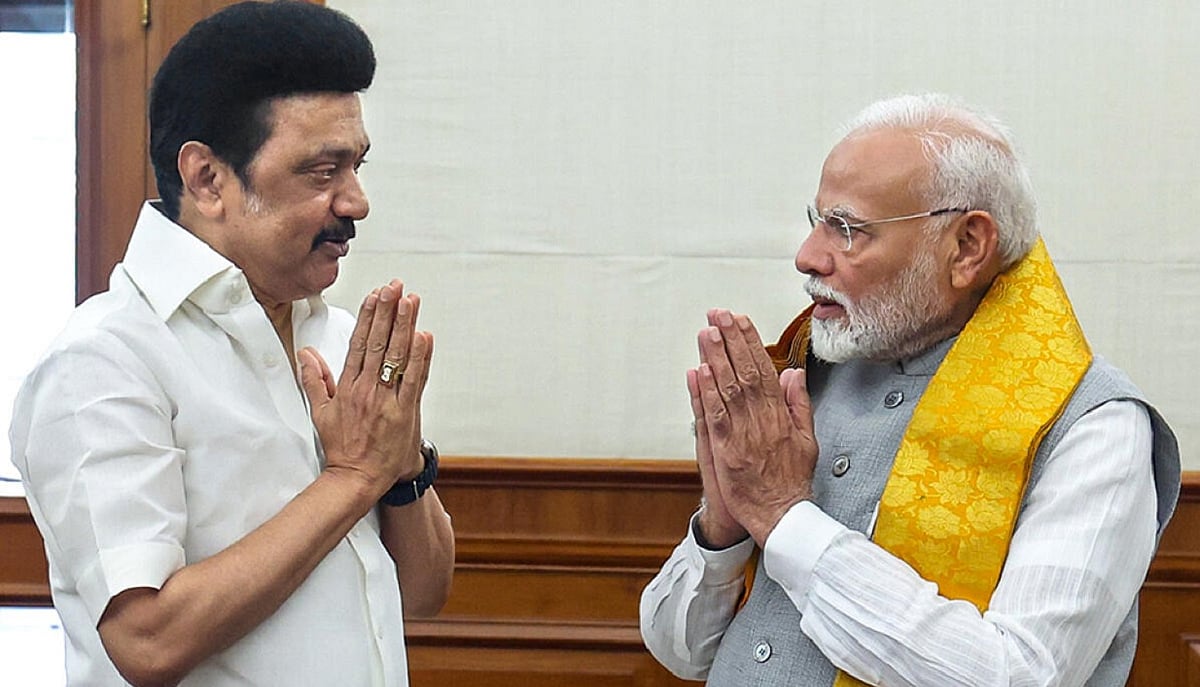
It was against this backdrop that a meeting of DMK Members of Parliament was held in Chennai on Saturday under the leadership of the party’s president, M.K. Stalin. At the meeting, a resolution was passed in support of the constituency delimitation bill.
Accordingly, the DMK has announced that it will support the fair constituency delimitation bill. The party also expressed confidence that the constituency delimitation bill to be introduced in the special session of Parliament will not have any adverse impact on Tamil Nadu.
In this regard, in an X post released by DMK president M.K. Stalin, “DMK supports the bill that has accepted the demands for fair constituency delimitation.
The two demands for which we opposed the constituency delimitation bill last April have now been included in writing in the new bill. This is a victory for the series of struggles undertaken by the DMK since 2024. It is a victory for Tamil Nadu and all the southern states.
If we miss this delimitation bill, which provides for a 50 percent increase in constituencies for all states based on the 1971 population, we should think a little carefully about what will happen, without getting emotional.
“After thoroughly examining all of this, the position has been taken that the DMK will support delimitation only if it is carried out in this form, which is feasible in practice and favorable to us,” DMK leader Stalin has explained.
With the ruling BJP alliance needing the support of 360 MPs to pass the women’s reservation and delimitation bills, political circles in Delhi have firmly said that the chances of this bill being passed with DMK support have risen significantly.
In this situation, various parties and organizations in Tamil Nadu have strongly opposed the DMK’s decision.
“In the delimitation issue, the DMK should not get caught in the BJP’s trap of more seats and proportional calculations. If the DMK trusts the BJP’s promises, it will incur an irreparable disgrace. Whatever stand Karnataka, Andhra, and Kerala take, that should be our stand as well,” said Dravidar Kazhagam leader K. Veeramani.
“The DMK’s support for the delimitation bill is deeply shocking. By doing so, the DMK has made a historic mistake. It appears as though the DMK is aiding the BJP’s conspiracy. The DMK’s position will endanger the nation itself,” said VCK leader Thol. Thirumavalavan.
“At this moment when the foundations of the federal structure of this great nation are under threat, history will never forgive those who remained silent, those who abandoned their responsibility, and those who stepped back from the duty of protecting the Constitution,” said Congress MP Jothimani.
At the same time, DMK MP A. Raja said, “This is not a decision taken now. When M.K. Stalin was Chief Minister, he passed a resolution in the Legislative Assembly. In accordance with the decision we took with the consent of all parties in that resolution, this decision has been taken.
After inviting the leaders of the opposition parties and the chief ministers of various states to Chennai and forming a joint action committee, and after that committee discussed the matter for a full day, this decision has been taken in accordance with the decision we arrived at.
“To portray it as though some new decision was forcibly taken just because the DMK is not in the INDIA alliance is a very disgraceful act. That is not political decorum,” said A. Raja.