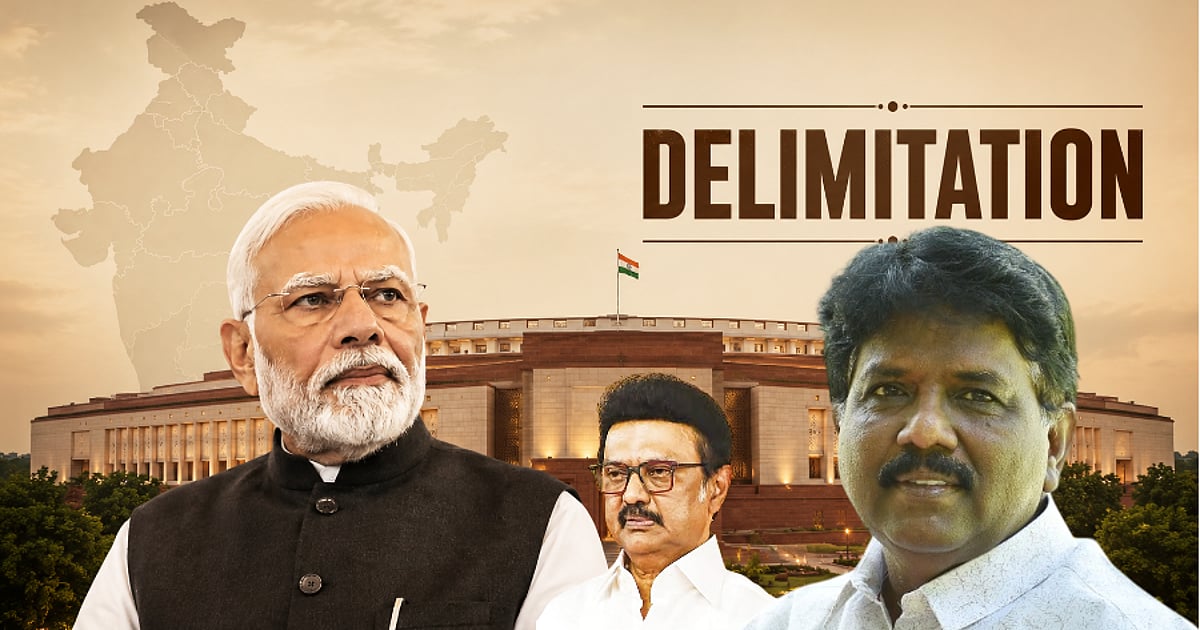
MP Ravikumar, who is the Member of Parliament for the Viluppuram Lok Sabha constituency and the General Secretary of the Viduthalai Chiruthaigal Katchi, has issued a detailed statement on constituency delimitation.
MP Ravikumar said, ``The Union government has released the ‘Constituency Delimitation (Second) Bill 2026’, which is to be introduced in Parliament on November 30. The bill has been proposed as an attempt to alter India’s federal structure itself. The 50 percent increase in seats included in it (Section 10) will pave the way for ‘the North to prosper and the South to decline’ and will also lay the foundation for permanently establishing their long-cherished dream of a majoritarian government.
The DMK, which last time voted against the delimitation bill and defeated the BJP government’s plan, and some parties including the Nationalist Congress Party (Sharad Pawar) now appear to be supporting these bills. They cite the 50% increase in seats as the reason. The question now is whether that reason is valid.
There is no disagreement with the view that women should be given reservation in Parliament and in state legislative assemblies. That is why all parties supported the 106th Constitutional Amendment passed in 2023. However, the law contains a condition that the reservation will come into effect only after the census and the subsequent delimitation of constituencies.
There is no need to increase the number of constituencies by 50 percent in order to provide reservation for women. The Constitution can be amended by revising Article 334A so that one-third reservation can be implemented within the existing constituencies themselves. But the new bill proposed by the Union government increases by 50 percent both the number of Lok Sabha constituencies allotted to each state and the total number of seats in state legislative assemblies.
Through this, it paves the way for weakening parliamentary functioning and turning it into nothing more than a gathering place for a crowd.
Along with this bill, the Union government has also circulated to MPs the bill titled ‘The Constitution (One Hundred and Thirty-Second Amendment) Bill, 2026’. Section 4(2) of that bill states that the current state-wise allocation ratio will not change and will be preserved until 2051.
Increasing the number of seats for all states at the same rate may seem to preserve the current proportional balance among states. But it does not address the fundamental issue of federalism. While claiming to preserve the current ratio, this bill further widens the numerical disparities that already exist between North India and South India.
A 50 percent increase is not merely a mathematical change; it is a move that alters the balance of political power and the structure of Parliament. Large states already have more constituencies. When their seats are increased at the same rate, the numerical gap between them and the smaller states widens further. This is nothing but an attack on federalism.
In the book Thoughts on Linguistic States, written by Ambedkar in criticism of the report of the States Reorganisation Commission in 1955, he clearly explained the dangers that large states could pose to Indian democracy and federalism. He proposed that large states such as Uttar Pradesh, Bihar, and Madhya Pradesh should be divided into smaller states.
He also proposed plans to divide Uttar Pradesh into three parts and Bihar into two. He believed that in a large state, communities that are numerically dominant could run the risk of concentrating power and administration under their control. The basis of his concern was that, to protect the rights of minorities and democratic participation, power should not be allowed to concentrate in one place. Instead of reducing the concentration of power in large states, the Union government is further increasing the number of their legislative assembly and parliamentary seats. This makes Uttar Pradesh a “super state” with the highest number of 120 Lok Sabha constituencies in India.
Reorganization Commission that ignores the states:
According to Section 5 of the Delimitation Bill, the commission will include three official members. They are:
1. A sitting or retired judge of the Supreme Court — who will serve as the chairperson of the commission.
2. The Chief Election Commissioner or an Election Commissioner appointed by him.
3. The State Election Commissioner of the concerned state.
The five Lok Sabha members and five Legislative Assembly members from the state concerned will be appointed as associate members. However, they will not have the right to vote. They also have no authority in determining the Commission’s decisions. In other words, the authority to make important decisions such as how a state’s constituencies are to be divided, how their boundaries are to be defined, and which areas are to be included in which constituency will remain with the three official members alone. Section 11(2) of the bill states that the orders of the Delimitation Commission cannot be challenged in court.
This sweeping power is not good for anyone.
It was by using its unchecked power that the Delimitation Commission altered constituency boundaries in a way favorable to the BJP in Assam and Jammu and Kashmir.
In the delimitation carried out in Jammu and Kashmir, 7 new constituencies were created — 6 of them were allotted to Jammu and one to Kashmir. Opposition parties criticized this as an obvious gerrymandering maneuver, changing boundaries to suit their own advantage.
The constituency reorganization carried out in Assam in 2023 was the same. It redrew constituency boundaries on the basis of the 2001 census. Constituencies such as Dhubri and Barpeta, where Muslims live in the majority, were arbitrarily split up; in doing so, the opposition parties’ vote banks were also scattered. Likewise, if constituency boundaries are altered across India, India can never be freed from the BJP’s grip thereafter.
The BJP is planning to use delimitation to legally establish the majoritarian government it has dreamed of. It is the duty of secular, social justice-oriented parties to stop it.
If the DMK is truly concerned about protecting state rights, it should press for the following recommendations of the Kurian Joseph Commission it set up during its rule:
“The constitutional provisions 82, 170, and 329(a) should be amended so that delimitation commissions come into effect only after a time-bound review by Parliament and the State Legislatures, and so that judicial review on constitutional and jurisdictional grounds is permitted before the announcement of elections.
At the same time, the bar on court intervention should continue after the election process has begun. Until such amendments are made, any delimitation law enacted by Parliament should provide for mandatory legislative review.”
“To separately establish the Union and State delimitation commissions in the Constitution, Articles 82, 170, and 327, as well as Entry 72 of the Union List and Entry 37 of the State List in the Seventh Schedule, must be amended. The authority for delimitation of Lok Sabha constituencies should be vested in a Union commission, and the authority for delimitation of State Legislative Assembly constituencies should be vested in separate State commissions. It must be constitutionally ensured that these commissions have multi-party representation and appointments based on electoral college principles.”
These are the recommendations of Justice Kurian Joseph’s commission. Will the DMK insist on these?
If the DMK supports the delimitation bill without insisting on these demands, it would amount to helping the BJP’s plan to permanently establish a majoritarian government. It is not right for the DMK to justify this by saying, “Congress has betrayed us, so we are taking this decision.” Supporting this bill would be nothing other than the DMK itself burying the state autonomy politics it has been advocating so far,” he explained.