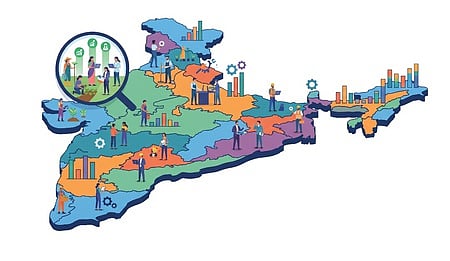
The National Statistical Office (NSO) has released the country’s first district-level labour market (employment) data.
Indicators of employment data such as the labour force participation rate (LFPR), worker population ratio (WPR), unemployment rate, and the proportion of youth not in education or employment have been released at the district level for the first time.
Accordingly, Surat in Gujarat has recorded the highest labour force participation and worker population ratio (68.6 percent and 67.8 percent, respectively). It is followed by Araria in Bihar and Salem in Tamil Nadu.
Bihar’s Darbhanga is far behind on both measures. In 98 percent of districts across the country, the labor force participation and worker population ratios for those aged 15 and above are between 40 and 80 percent.
Women’s employment...: The data show significant differences among districts in women’s participation in employment.
Hamirpur in Himachal recorded the highest women’s participation at 80.9 percent. Budgam in Jammu and Kashmir (71.4 percent), Mayurbhanj in Odisha (71.8 percent), and Surguja in Chhattisgarh (69 percent) are next.
East Delhi (18.9 percent), Siwan in Bihar (24.7 percent), and Patiala in Punjab (39.3 percent) have the lowest participation. Overall, 57.8 percent of districts have recorded a female labor force participation rate of 40 percent or more.
Unemployment rate: At the same time, district-level unemployment rates are relatively low. About 43.1 percent of districts have recorded unemployment of 0.5 to 3 percent, and 34.7 percent of districts have recorded unemployment of 3 to 5.5 percent. Only 14.9 percent of districts have unemployment above 5.5 percent.
South 24 Parganas in West Bengal and Araria in Bihar have recorded the lowest unemployment rate (0.9 percent).
Similarly, the proportion of young people aged 15-29 who are not in employment, education, or training has been recorded at less than 30 percent in about 76.2 percent of districts.
Ernakulam in Kerala has recorded the lowest rate at 9.6 percent. It is followed by Coimbatore in Tamil Nadu at 14.5 percent and Bengaluru Urban at 15 percent.