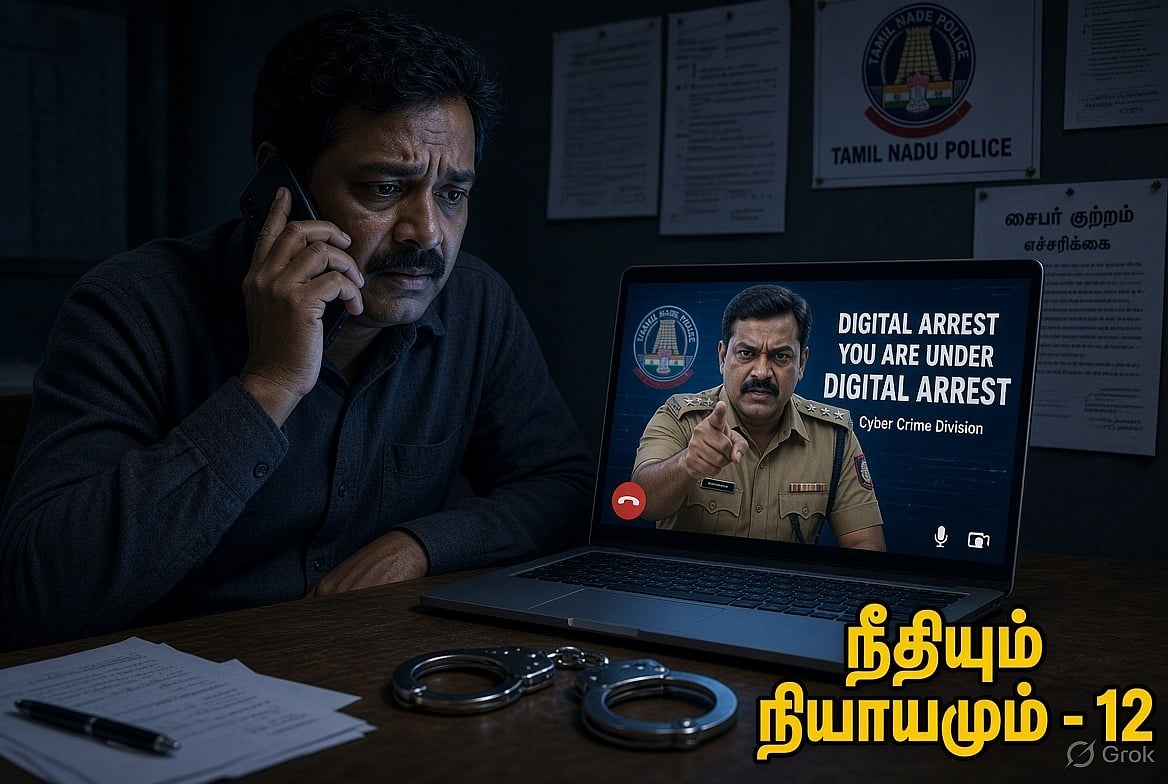
Pandian runs a grocery store opposite the office. His house is nearby. A first-generation business success. He greets me at least twice a day. It was early morning that day. I was in the office. He rushed into the office in a panic.
“What’s wrong, Pandian?” I asked. He was holding a cellphone and looked slightly sweaty.
“They’re going to arrest the girl in a drug smuggling case, sir,” he said. Panic had spread through his whole body. The man broke down in tears. I understood.
Pandian’s daughter is studying in her final year of B.E. at a well-known private college. She comes home only once every three months during the holidays. She is a good student. Energetic. Without fail, Pandian would go in person every month to see his daughter.
“Pandi... did you switch off the phone?” I asked.
“I didn’t know what to do, sir. They said, ‘We’re calling from the CBI office. Your daughter is involved in a drug smuggling case... we’re going to arrest her, so listen carefully to what we say.’ As soon as they said that, I switched off the phone and rushed here, sir,” he said.
“You’ve done the right thing, sit down without worrying,” I said. He sat down. I gave him water and comforted him.
I explained that it was one of the members of the ‘Digital Arrest’ scam gang, which is currently threatening all of India, who had contacted Pandian. Every year, people lose several thousand crore rupees to such digital scam gangs.
“I feel like I’ve just come back to life. I need to talk to my daughter right away, sir,” he said.
“Speak freely, but don’t say anything about what happened at this time.. It’s early morning. When you meet them in person, calmly explain what happened. Just tell them, ‘If you get a call from an unknown number, don’t answer it,’” I said.
“I’ll go take a quick look and come back, sir,” he said.
“Don’t do anything out of the ordinary. Just go and check during the holiday, that’s enough. Tell the cybercrime number about the number that called you,” I said and sent him off.
Such fraud gangs are now becoming more active. In general, the local police do not take any action regarding complaints of this kind. They do not pay much attention to them either. Our police force also does not have a system in place to investigate such complaints.
People should organize their lives with transparency. Even if there is no transparency in public, at the very least they should live transparently with their family members. A lack of transparency in one’s way of life is the cause of many problems. Fear will slowly consume a person. It is people’s fear that becomes the capital for online fraud gangs.
Pandian had confidence in himself and in his daughter. He was anxious, but he did not lose his composure. He was someone who, with a clear conscience, had done no wrong. Even after being told that he was a CBI officer, he switched off his mobile phone and rushed to the lawyer’s office. Only those who live with transparency can make the right decision in a crisis. If Pandian had had any fear or guilt; if he had been afraid of what his family would think, what the town would think; he would have fallen into the trap set by the fraud gang. He would have lost several lakhs. He would not have been able to switch off the phone.
Here a question arises for us. How did the fraud gang know that Pandian was someone who could do business in the range of a few lakhs, and that Pandian has a daughter? It is in this context that the Supreme Court’s suo motu action on “Digital Arrest” has become significant, as it has registered and is hearing the case In Re: Victims of Digital Arrest Related to Forged Documents, Suo Motu Writ Petition (Criminal) No. 3 of 2025.
Based on the judgment in the case concerning ‘Digital Arrest’ currently under hearing before a bench comprising Chief Justice of India Surya Kant and Justices Jaymala Baxi and V. Mohana, detailed laws on ‘Digital Arrest’ may be developed in the future.
During the hearing held in the Supreme Court on 29.10.2026, the Supreme Court warned that ‘if the concerned bank officials are involved in the fraud, or if it is due to the bank officials’ negligence (due diligence failure), the concerned banks themselves may be required to pay compensation of an amount not less than the lost sum.’ The case is pending.
Those who are weak both mentally and physically are the ones targeted by fraud gangs. In particular, the members of the money-extortion “digital arrest” gang target the elderly, retired government employees, and people living alone at home. Those who come on video calls (WhatsApp Video Call) claim to be police officers, or CBI officers, or customs officials, or enforcement department officials, or telecom department officials. The scenes shown in the video are also convincing and do not arouse suspicion. The government and the media have been continuously warning people about this.
Members of the gang involved in video-call scams will threaten the people on the other end by accusing them of things like, “Narcotics have been smuggled using your Aadhaar number and PAN number,” or “A financial fraud has taken place,” or “Financial assistance has been provided to a terrorist organization.”
“You have been digitally arrested; you must not go anywhere else; you must not disconnect from the video call,” they will threaten. “If you want to be released from the case, send money to the bank account we tell you,” they will say. If they get caught up in any case, out of fear of what their family will think about them and what the people in this town will think, they will share all the information they are asked for with the fraud gang. The connection will be cut off. Before they even realize they have been deceived, all the money transfers will be completed. They will have lost all their life savings in a matter of seconds.
Those who engage in online fraud and illegally obtain money do not directly transfer the money into their own / the criminals’ bank accounts. They collect bank accounts from many unsuspecting innocent people by saying, “If you receive our business money in your bank account and transfer it to another bank account, we will give you a commission.” The money obtained through fraud first goes into the bank accounts of innocent people under their control. From there, it is transferred to another account, and then from there to yet another account.
As soon as the victim realizes that they have been defrauded, they should immediately inform the cyber crime unit. There are ways to recover the money. In many cases, it has been recovered. With every minute of delay, the money keeps getting transferred to different accounts. The money may become impossible to recover. The fake bank accounts used by fraud gangs are called Mule Accounts. Across the country, thousands of such mule accounts have been identified and frozen by the police.
“Do not share details such as your Aadhaar number, bank account number, ATM card number, etc., with anyone,” banks have been repeatedly warning. If you give out your bank details in the hope of earning a commission, there is no way to avoid getting caught in a fraud case and going to jail.
It has been found that people have lost Rs. 3,000 crore in the past year alone due to digital arrest scams. Senior citizens have lost their life savings. As a result, many senior citizens are being driven to a tragic death. As science has advanced, fraud has also advanced. NITI Aayog is deeply concerned about this. It is engaged in consultations to completely prevent this. The National Human Rights Commission is also considering the human rights impacts caused by digital arrest scams and is deliberating on the matter.
“Digital arrest” is a practice that does not exist in Indian law. However, fraudsters are carrying it out. The damage caused by it is shaking the Indian economy itself. Our people have lost the common sense that no police officer ever calls on a video call to discuss a case.
There is a famous film song that says, “If you do not reform after seeing a thief, theft cannot be eradicated.” It was written by Pattukkottai Kalyanasundaram in 1961. Sixty-five years have passed since the song was written. Theft has not been eradicated. The nature of theft has evolved. People must wake up. Aadhaar numbers and bank details must never be shared with unknown persons. The OTP received from the bank must not be shared with anyone. If you receive a threatening call on a video call, you must immediately report it to the Cyber Crime helpline number: 1930. A complaint should be registered on the National Cyber Crime Reporting Portal website. Although action is not taken on every complaint, the truth will come out in some situation. The criminals’ chain of deception will be broken.
“Digital arrest” is a new term in Indian criminal law. Its definition is something the present era itself must write. There is no separate law specifically for preventing crimes related to “digital arrest.” Under Section 66D of the Information Technology (IT) Act, 2000, punishment can be imposed for cheating by impersonating another person using computer and communication devices, and under Section 66C, for fraudulent use of passwords and electronic signatures, as well as identity theft.
Action can be taken in connection with digital arrest fraud under the provisions of Section 318 of the ‘Bharatiya Nyaya Sanhita’ for cheating and fraud committed by dishonest inducement, Section 319 for impersonation and cheating (for example, disguising oneself as police, CBI, Enforcement Directorate, or customs officials), Section 308 for extortion through coercion other than threats or intimidation, and Section 61 for criminal conspiracy between organized groups engaged in criminal activities.
Those involved in the ‘digital arrest’ scam cannot be ordinary people. They can only be people who are well versed in information technology. Where do they come from? They come from this very society. The highest aspiration of young people is a White-Collar Job. That is, office work or intellectual work. Not only for young people, but for parents too, that is what brings prestige. A job opportunity that suits one’s needs does not work out for everyone. At times, it ends in unpleasant events such as disappointment, loss, betrayal of trust, and fraud. Many people move past it. But some are unable to bear it. They go so far as to decide to take revenge on society as a whole. Digital criminals (White-Collar Criminals) are formed in such circumstances. From them, one cannot expect even a trace of compassion; it will not be there. The criminological principle that ‘strict laws create skilled criminals’ becomes true here.
In this era of increasing online money transfers, banks have a greater responsibility to protect their customers. When transferring money in the lakhs, some private banks immediately call the customer on the phone. They make sure that “your transaction is reaching the right person.” Just as banks call and speak to the customer immediately after money is transferred from one account to another, they should also make it mandatory to call and speak to the customer when sending an OTP number to seek approval for a money transfer.
The customer can be alerted. Software for such a facility must be developed. It is not an impossible task. The loss to the customer is not only for the individual. It is also a loss for this country.
The voice for justice will resound...
The journey toward fairness will continue...
Author : Lawyer, social activist
Tamilmani Arumugam, Advocate.
advocatetamilmani@gmail.com