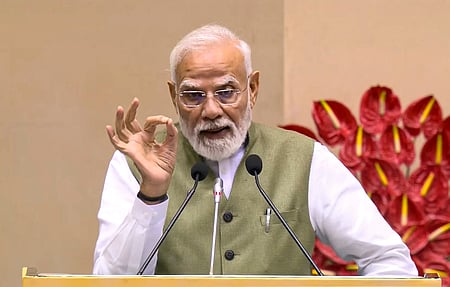
Developed countries, based on per capita numbers, emit six times more carbon dioxide than India. However, an unfair accusation is being made that developing countries are responsible for the climate change problem, Prime Minister Narendra Modi said.
Speaking at the inauguration of a two-day international conference on environment and climate in Delhi on Saturday, Prime Minister Modi said:
India is making rapid progress in nuclear power generation. But whenever nuclear power generation is advanced, those who speak most about the environment file cases in courts to block the government's nuclear power projects.
What is the truth?: We all know that accusations regarding carbon emissions are often wrongly placed on developing countries. But the historical truth is that even today, India’s per capita carbon emissions are less than half the global average. At the same time, the average per capita carbon emissions in developed countries are six times higher than India’s. India has been consistently highlighting this truth on the international stage.
India is working hand in hand with countries around the world. We are creating new standards in environmental protection. At the same time, our country’s growth is rapid and stable. India is giving priority to the use of renewable energy, including solar power generation and wind power. This is the strength of New India.
Environmental protection: Over the past 12 years, India’s wind power generation capacity has tripled, and hydropower generation has increased significantly. We are also rapidly advancing nuclear power generation. In these sectors, the government is creating opportunities for private companies to participate as well.
Solar power generation in every home: Renewable energy has been our main focus. It has played an important role in environmental protection. Through the Prime Minister’s Solar Power Generation Scheme, the government is carrying out the work of transforming homes into centers that generate solar power.
Under this scheme, solar panels have been installed on the rooftops of more than 50 lakh homes. This is more than the total number of homes in many countries around the world. Under this scheme, the government is providing an additional subsidy of about Rs. 80,000 for each home.
India’s achievements: India is also moving rapidly in sectors such as eco-friendly transportation vehicles and green hydrogen. Recently, India’s first hydrogen train was launched. It is the world’s longest hydrogen train. Before 2014, only 3,000 electric vehicles were sold annually in India. But in just the past year alone, about 2.5 million electric vehicles have been sold.
Before 2014, metro rail service was available in only 5 cities in India. Its total length was less than 250 kilometers. But now, metro rail services spanning more than 1,000 kilometers are operating in 20 cities across India.
Furthermore, through the railway’s 100 percent electrification, we have reduced the use of diesel by millions of liters. This has also helped our environment.
From rainwater harvesting to afforestation: under the ‘Catch the Rain’ initiative, around 1.5 crore rainwater harvesting structures have been created across the country. Natural farming clusters have been established over an area of 12.5 lakh hectares. We have also developed around 3,000 varieties of crops that can withstand climate change.
Promoting agroforestry is helping reduce pollution. Over the past 12 years, dense forest cover has increased by 22 percent. India has a ban on single-use plastic, said Prime Minister Modi.