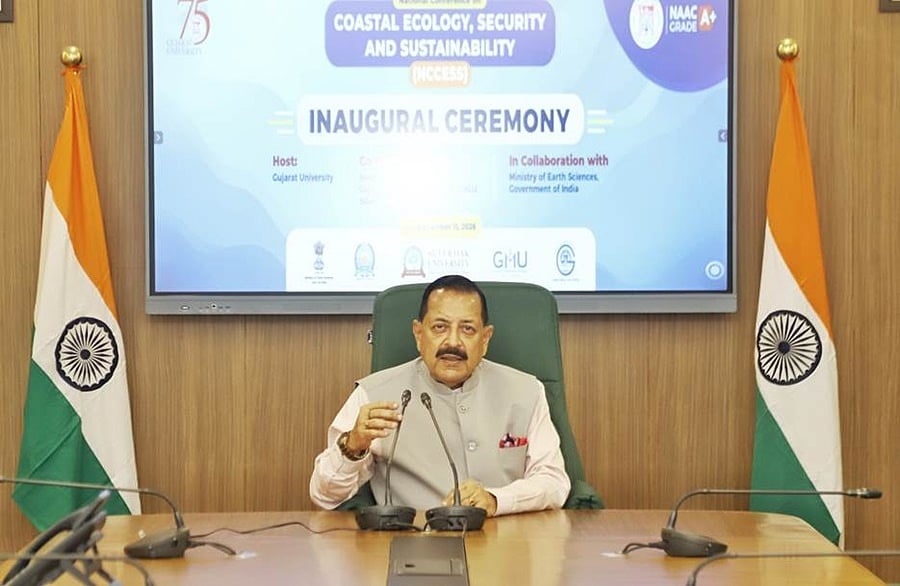
New Delhi: The Indian maritime domain should be regarded as an integrated part of ecology, security, economy, technology, and human resource development, and the Deep Ocean Mission and indigenous technologies are creating new opportunities for exploring marine resources, said Union Minister of State Dr. Jitendra Singh.
Speaking via video link at the 'Coastal Ecology, Security and Sustainability' 2026 conference, he said:
India's 11,000 to 12,000 km-long coastline offers vast opportunities for marine resources and the "blue economy."
The country’s long coastline and maritime environment offer significant opportunities, while also calling for an approach that integrates science, environmental sustainability, security, and economic development.
India, with the world’s largest maritime expanse (12,000 km in length), emphasizes the importance of the ocean and coastal regions in the country’s future development. Our historical connection with the sea reflects the knowledge and understanding our ancestors had of the maritime environment.
To take the country’s economy to the next level, attention must be directed toward resources that have not yet been fully explored. He said that marine and coastal resources, including metals, minerals, and fisheries, are sectors with significant potential, and that work has begun to explore the largely unexplored resources in the deep sea, for which domestic capabilities are being strengthened.
In order to promote domestic marine research, the country’s state-of-the-art oceanographic research vessel, Sagar Manthan, has been brought into service. This will help India achieve self-reliance in deep-sea exploration.
He also highlighted that possibilities for extracting marine minerals in the future are being explored, along with efforts aimed at increasing the economic potential of the fisheries sector.
Marine surveillance, reconnaissance, communications, remote sensing, data, and emerging technologies can play a key role in strengthening the country’s understanding of and preparedness for the marine environment and coastline.
Robots and deep-sea exploration vehicles are also being developed to explore the depths of the ocean, and deep-sea exploration projects and indigenous technologies are creating new opportunities for investigating marine resources.
Furthermore, he said that the conference would help develop expertise in marine research and also create an understanding of maritime challenges among those in geoscience, education, defense, maritime institutions, and industry.
India’s maritime environment should be regarded as an integrated part of ecology, security, economy, technology, and human resource development. Coastal ecology and coastal security cannot be addressed separately. Resilient coastal regions require healthy marine ecosystems, aware communities, effective governance, and strong scientific capabilities.
He emphasized the importance of linking marine science with national policy so that scientific knowledge directly contributes to coastal planning and management, and highlighted the role of coastal communities, noting that they are an integral part of the coastal ecosystem. He said that efforts to expand the economic potential of coastal resources should focus not only on protecting the environment but also on improving the livelihoods of people living along the coast. Their livelihoods, traditional knowledge, and participation are essential for sustainable coastal development. He said that the country’s coastal infrastructure and ports serve as a hub for connectivity and trade.