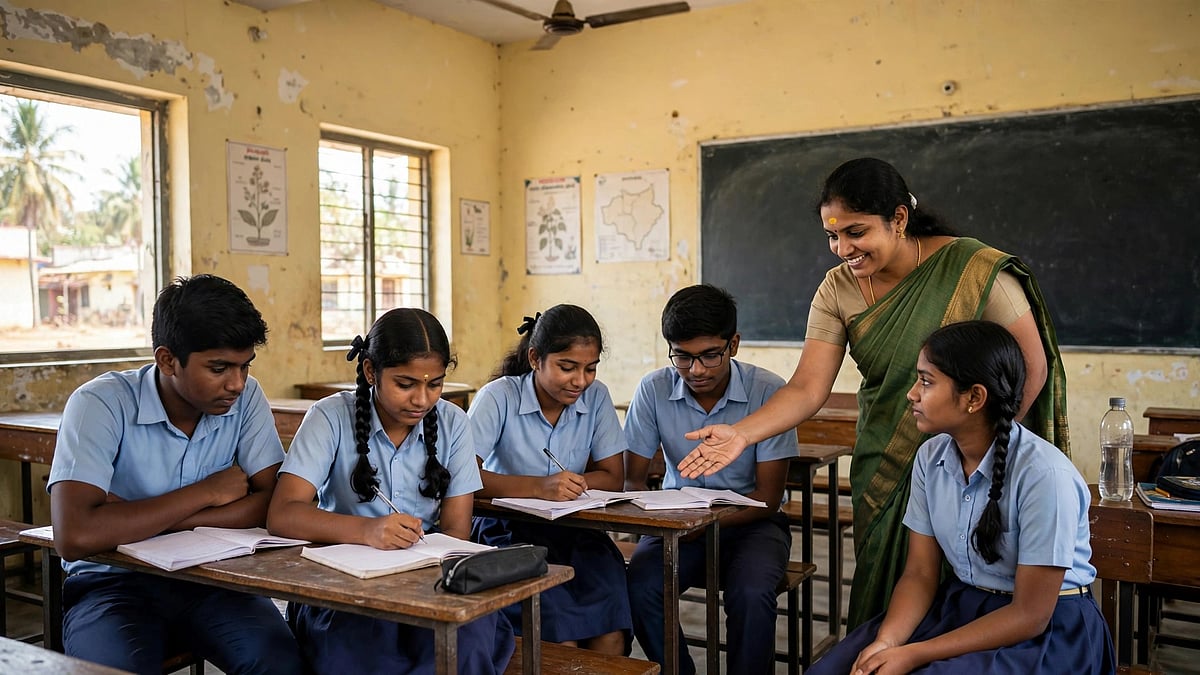
I still remember a day when I went to a school to speak with the students. I visited different classes and spoke with the students. I talked with them. I also carried out some assessments.
At that time, in one class, many students said some similar things. “This teacher is not good...”, “They do things like this...”, “We don’t like that...” — they listed complaints about the teachers.
Then I spoke to the teachers. The story I heard there was completely different. “Ma’am, these kids are just like this. They have no discipline. They won’t listen to anything. They behave aggressively toward us. They break our things. They don’t respect us,” the teachers shared their experiences.
While speaking with them, one thing became clear: both teachers and children are struggling.
There may be many reasons behind teachers’ frustration. Work pressure, burdens from personal life, administrative pressures, lack of adequate recognition, disappointments about promotions, dissatisfaction with salary, and years of accumulated occupational burnout... all of these can affect a person’s emotional resources.
Many teachers go to work in the morning as if they are packing their personal sorrows into a bag and bringing them along. They may even have to enter the classroom with the mindset of, “Somehow, I just need to get through this day.”
It is not fair to simply tell teachers, without understanding the situation, “You need to be more patient. You need to understand children.”
Even when a teacher tries to solve a problem with good intentions, school rules, parents, fellow teachers, students, and situations with incomplete information can complicate their decisions. Good intentions alone do not guarantee the expected outcome. At the same time, we cannot forget the students’ side either.
Because students are a vulnerable group. A teacher and a student do not have the same level of power, experience, or opportunity to choose.
A teacher may have the maturity to handle a difficult day. But a student has to return to the same class every day. Avoiding conversation with the teacher, leaving the school, or changing the situation on their own is often not in the student’s hands. That is why acknowledging teachers’ difficulties and keeping students’ needs at the center are not opposing things.
So, what kind of teacher does a student need?
At the same school, I asked the students another question: “What should a teacher be like for you?”
Their answers were interesting.
Even the children who said, “We don’t like this teacher,” also said, “It would be good if they changed just a few things.” They were not rejecting teachers altogether.
At the same time, when speaking about a particular teacher, many children’s responses changed completely. That teacher seemed like a safe person to them.
“If we have any problem, we can tell him.”, “He talks with us.” “He has given us books.”, “If we have any problem, he tells us to come to the office and talks to us.” — there was a sense of reassurance in their voices about that teacher.
This is where the key question of this chapter comes in:
One school. The same kind of students. Teachers facing the same kind of work pressures. But why do students feel safe with one teacher... and not with another?
One reason for this can be the relational experience.
Students do not just learn lessons at school. They also gradually learn, ‘Who am I?’, ‘What can I do?’, and ‘What do others think of me?’
According to the concept of the looking-glass self, the way we form our sense of ourselves is influenced in part by our view of what others think of us.
As children’s self-concept is still developing, “What does this adult think of me?” may be important to them.
“If I ask a question, will they think I’m stupid?”
“If I make a mistake, will they think I’m a bad student?”
“If I want to say something, will they listen patiently to me?”
Students may not ask these questions openly. But in the classroom relationship, they may keep experiencing the answers to them.
When a teacher does not merely point out the mistake, but instead asks, “What went wrong here, and how can you try next time?”, the student can learn the distinction: “I made a mistake, but I am not a wrong student.”
Similarly, small relational experiences—such as respecting a student’s question, noticing the effort behind it, and making space to speak when there is a problem—can create the feeling, “Here I am heard; here I can try.”
So, it cannot be said that a teacher shapes a student’s entire personality. However, repeated experiences with the teacher may become part of the ideas a student forms about themselves, about learning, and about adults.
That is why, when a teacher repeatedly begins to see a student as ‘lazy’, ‘troublesome’, or ‘weak’, that labeling may not remain merely the teacher’s opinion; it can also affect the student’s identity in the classroom.
Along with this, one can also relate it to psychological studies on teacher expectations and self-fulfilling processes (Teacher expectations and self-fulfilling processes).
A teacher’s expectations can, in some situations, affect students’ engagement and performance. But this should not be exaggerated into saying that “a teacher’s words determine a child’s future.”
So, a small change in feedback is important. Instead of saying, “You are a careless student,” saying, “There are some things you missed in this assignment. Let’s see how you can fix them next time” talks about the behavior without attacking the student’s identity.
But what should the teacher do?
The answer is not simply that “teachers should do even more.”
Before deciding “this student is just like this” as soon as you see a student’s disruptive behavior, you can think, “What is this behavior telling us?”
Is a student constantly talking? It may be attention-seeking behavior. Or there may be other reasons.
Is a student staying quiet? That does not necessarily mean good discipline.
Is a student resisting the teacher? It may be disrespect. Or it could be frustration, unmet needs, or relationship problems.
This does not mean the teacher must look for a psychological explanation for every behavior. What matters is the mindset of trying to understand with curiosity before judging (Curiosity before judgement).
Moreover, the teacher-student relationship is not a relationship without boundaries. A teacher does not need to become a student’s friend or a mental health professional. Both a caring approach and structure are necessary. It is possible to respect students while also maintaining rules.
Abuse, neglect, or changes in a student’s mental health and well-being often first become apparent in their behavior.
Teachers who see students every day can notice these changes early. Therefore, when it comes to students’ mental health and safety, teachers are a very important first point of contact.
So, what is the role of a mental health counselor?
A mental health counselor (Psychologist) can talk to teachers not only about “How do we approach students?” but also about “How do we understand students?”
Teachers can be trained in child development, motivation, emotional regulation, active listening, validation, constructive feedback, classroom relationships, boundaries, and referral.
At the same time, teachers’ own wellbeing must also be taken care of. Expecting limitless patience every day from a teacher who is emotionally exhausted is not practical. Support for teachers is only one part of supporting children.
At the same time, understanding teacher stress does not reduce the student’s needs.
The student is the center of this relationship. Because the student is still growing. They have less power. They may not always have the ability to choose whom to turn to when they need help.
So teachers should not think, “I have not made a big impact on my students’ lives.” A child may forget an entire course syllabus many years later. But they may remember, “I had a teacher who listened to me when I had a problem,” or, “There was someone who did not see me as a mistake even when I made one.” That is the impact of a teacher.
It does not always have to be a big, inspiring speech. Sometimes it is a conversation. Sometimes it is a patient response. Sometimes it is a boundary. Sometimes it is the courage to say, “I misunderstood.” And sometimes it is taking them to the right expert and saying, “I am not enough to solve this problem alone; you need more help.”
A good teacher is not someone who solves all of a student’s problems.
But rather, someone who can help the child feel that they are not alone. For that, the teacher does not have to be perfect. The child does not have to be perfect either.
What matters is recognizing that there is a human relationship between the two, and providing teachers with the support needed to protect that relationship.
Because information may be available today on Google and in AI tools. But a student beginning to believe in themselves, daring to ask questions, recovering from mistakes, asking for help... these are still learned through relationships with other people.
More to come...
Contact: silviaise2021@gmail.com
Edited by Shalini