“Even if we are resting and sleeping at home, our investment should work for us and keep earning more and more money” is advice often given by experienced people in the business world. But in China, can you believe that without making any financial investment at all, a person’s very ‘face’ can earn them lakhs?
Artificial intelligence (AI) technology has completely turned upside down the idea that to earn money one must work hard, strain the body, and devote hours of time. How would it be if, even while we are sleeping, our face acted online on our behalf and earned money for us?
This matter, which may sound like some kind of science fiction story, has today emerged in China as a massive commercial revolution.
There is no need to stand in front of a camera. No need to put on makeup. No need to travel around shooting in rain or sun. Without any hard physical labor, Chinese people are making lakhs of rupees by renting out just their “faces.”
At a time when there is a global fear that artificial intelligence will take away human jobs, that very AI technology is turning human appearance itself into capital and creating new income opportunities.
The ‘micro-drama revolution’ in China
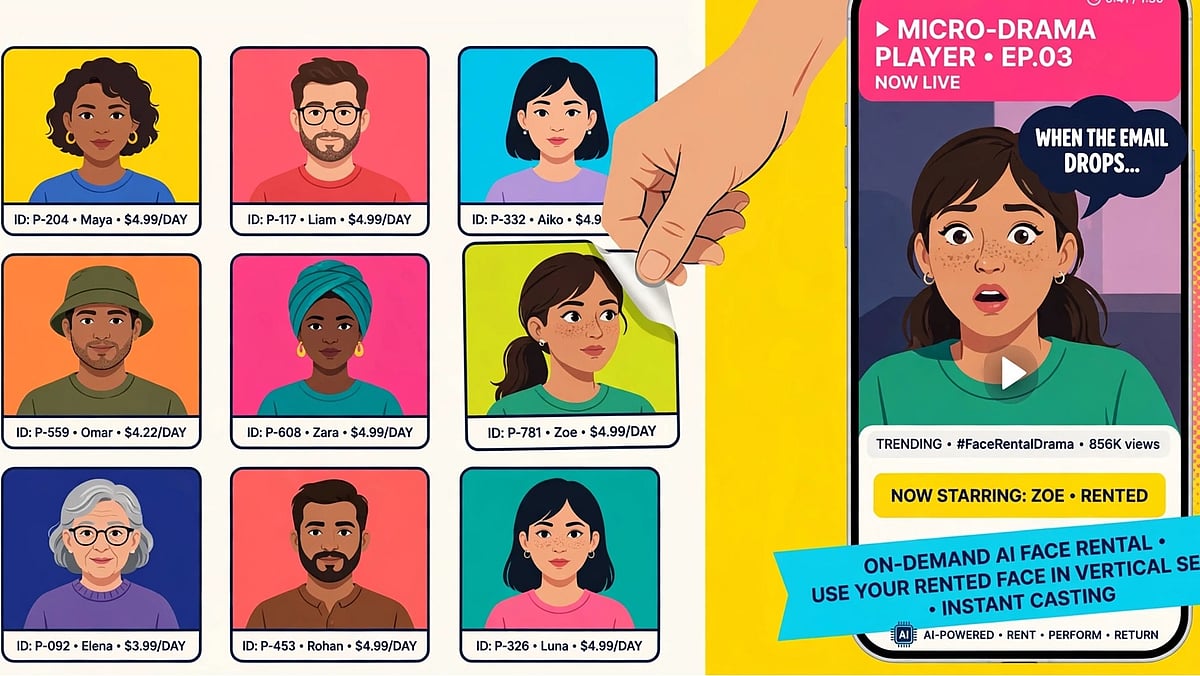
In China’s current micro-drama boom and online commerce, AI faces are being used on a large scale in place of human actors. What is interesting is that all of those faces are actually rented faces of ordinary people like us. In China, this “AI face renting” industry is now the biggest trend.
“One-minute dramas” released on social media platforms like TikTok and WeChat have created a huge market. Of the 128,000 micro-dramas released in just the first quarter of 2026, 95% used artificial intelligence.
It is enough for one person to write the story. Instead of needing actors in person for acting, AI is used to make the characters perform. As a result, film production costs are reduced by up to 80%. Likewise, production time, which could take up to 3 months, is cut down to just 1 hour. As a result, the demand for actors, models, and makeup artists has decreased, and a new market has emerged that uses the faces of ordinary people.
How do you rent out your face?
This new technique of earning income without standing in front of a camera in person is called “Digital Likeness Licensing.”
On platforms in China such as ‘Act-ID’ (ActID), New Claw (New Claw), and Yuanxiang (Yuanxiang), people upload their photos and obtain certification. Those who are certified can earn money by renting out their faces for short films, advertisements, and video games.
When high-quality photos of a person’s face are uploaded from different angles, AI technology converts them into a 3D digital avatar and adds it to its catalog. Advertising producers then choose the faces that suit them.
While a person is busy with their regular office work or spending time with family, their AI face may be appearing in a drama on Chinese mobile screens and earning money. A new revenue opportunity market that turns only “appearance” into capital is booming in China.
Fees and licensing
The rental amount varies depending on the face’s charm, popularity, usage period, and contract terms.
> It ranges from $15 to $74 per episode (approximately Rs. 1,200 - Rs. 6,000).
> Ordinary people receive between $300 and $700 when they lend their face for a few short films.
> Some people earn fees of up to $15,000 (about Rs. 12.5 lakh) for exclusive global advertisements.
People obtain an AI licensing certificate precisely so that their face is not misused. Of the 800 users registered with the Act-ID company, 300 have agreed to grant a license.
What are the risks?
Although this industry is growing very rapidly, it is not possible to fully control the problem of face theft. People are shocked to see their faces being used in AI productions they did not consent to.
Recently, ByteDance’s “Hongguo” company removed 85,000 unauthorized videos after allegations arose that it had used faces without permission. Chinese internet courts have also heard around 700 related cases.
Once you give away your face, it becomes very difficult to control the contexts in which it is used.
There is also the risk that it may be used without permission for false information, pornographic content, or criminal activities.
China’s face-rental industry, while providing extra income to ordinary people, also presents new challenges related to personal privacy and face identity theft as a warning to the world.