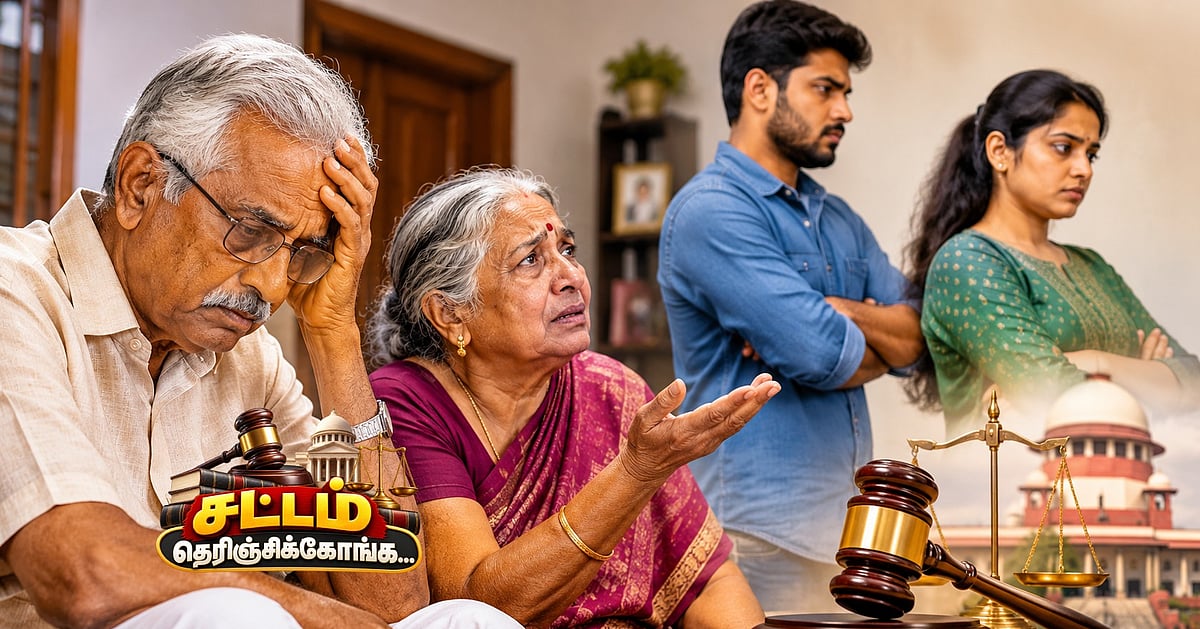
“Our own children have abandoned us… who will take care of us in our old age?” We have seen parents standing in tears saying this. This is the pain of parents who have to depend on others for food and medicine in old age. It is the duty of children to care for their aging parents; if they fail to do so, what does the law say?
Legally, maintenance is not just giving money every month. Food, clothing, shelter, medical assistance, and treatment are also included in maintenance.
*Caring for parents is a legal duty!*
The Maintenance and Welfare of Parents and Senior Citizens Act, 2007, and the Tamil Nadu Maintenance and Welfare of Parents and Senior Citizens Rules, 2009, protect parents’ rights to maintenance.
Under Section 2(h), only Indian citizens who have completed 60 years of age are considered “senior citizens.” However, under Section 2(d), biological parents, adoptive parents, stepfather, and stepmother also fall within the definition of “parent.” According to this definition, parents do not have to be senior citizens. Therefore, it is not mandatory to be 60 years old to claim maintenance on the basis of being a parent.
Under Section 4, parents who are unable to support themselves from the income or property they receive may claim maintenance from their adult children. It is the children’s duty to meet their parents’ basic needs and provide the support necessary for them to live a normal life.

*Daughters also have a responsibility!*
Some people think, “Only the son should take care of the parents; once the daughter is married, she has no responsibility toward them.” That is wrong!
Under Section 2(a) of this Act, son, daughter, grandson, and granddaughter are included within the definition of “children.” Minors are not included in this. Even if a daughter is married, if she has sufficient income of her own, she has a responsibility to maintain her parents, subject to the conditions of the law.
In this regard, in the case of Dr. (Mrs.) Vijaya Manohar Arbat v. Kashirao Rajaram Sawai (1987), the Supreme Court held that under Section 125 of the old Code of Criminal Procedure, maintenance for parents can also be claimed from a married daughter.
The court noted that the daughter must have sufficient income of her own, and that the parents must also be in a position where they are unable to support themselves.
*How much maintenance can be obtained?*
Parents can apply to the Maintenance Tribunal under Section 5 seeking maintenance.
If a family has more than one child, an application may be made not only against one of them, but also against more than one child. The legal basis for this is found in Section 5(5). However, it cannot automatically be decided that all the children must pay an equal amount; the tribunal will determine the maintenance amount by taking into account the relevant circumstances, including each person’s income.
Under Section 9, the tribunal may determine a monthly maintenance amount, taking into account the parents’ maintenance needs. Under Tamil Nadu Rule 15, the monthly maintenance amount may be fixed at a maximum of only ₹10,000.
Moreover, it should not exceed the amount obtained by dividing the child’s total monthly income by the number of family members. The parent seeking maintenance will also be included in this calculation.
This does not mean that everyone will receive ₹10,000. The amount will be determined only after considering relevant factors such as the parents’ basic needs, the child’s income, and the number of family members.
In situations where parents cannot apply directly, they may also apply through another person authorized by them or through a registered organization. The tribunal may also take up this issue for inquiry on its own. While the application is pending, interim maintenance can also be sought under Section 5(2).
*What happens if the order is not obeyed?*
Even after the tribunal orders maintenance to be paid, if the children fail to pay that amount without sufficient reason, recovery proceedings may be initiated under Section 5(8).
First, the Tribunal may issue a warrant to recover the unpaid amount through the procedure for recovering the penalty amount. If the amount remains unpaid even after recovery proceedings are initiated through the warrant, the Tribunal also has the authority to impose imprisonment for up to one month in respect of the unpaid monthly amount. If the amount is paid, the imprisonment will end earlier.
It should also be noted that an application for recovery must be submitted to the Tribunal within three months from the date the amount became due.
*Did you get cheated after signing over your property?*
Under Section 23, senior citizens who have completed 60 years of age must have transferred their property by way of gift or otherwise after this Act came into force. At the time of such transfer, there must have been a condition that the person receiving the property should provide the basic amenities and physical needs required by them. However, if the person who received the property refuses or fails to fulfill that condition, they may, subject to the specified legal conditions, seek to have that property transfer declared void.
For this, one must approach the Maintenance Tribunal for Senior Citizens. The property transfer does not get cancelled automatically; at the request of the senior citizen, the tribunal may declare the transfer void after examining whether the required conditions have been fulfilled.
Where should one apply?
One can apply by approaching the Maintenance Tribunal having jurisdiction over the area where the parents reside. In Tamil Nadu, action under this law is taken through officers appointed at the district level. If the parents are unable to go in person, they may also seek the help of an authorized person or organization permitted by law.
*Caring for parents is not just an expression of love; the law also provides protection for it. When parents’ rights are ignored, the law is there to stand by them!