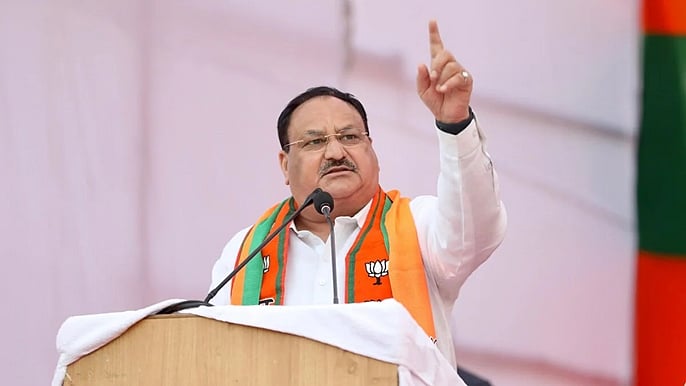
New Delhi: Union Health and Family Welfare Minister J.P. Nadda said on Saturday that the central government has approved the addition of 320 new postgraduate medical seats in 6 medical colleges in Himachal Pradesh, with a grant of about Rs. 415 crore.
In a statement related to this, a recommendation letter was received from the Himachal Pradesh government on June 23. Following this, this approval was granted after Chief Minister Sukhvinder Singh Sukhu consulted with me on the matter during the convocation ceremony held at the Bilaspur AIIMS campus on October 6.
Under the government led by Prime Minister Narendra Modi, several revolutionary initiatives have been implemented in the medical education sector over the past 12 years. In this regard, approval was granted last year for schemes to create additional undergraduate and postgraduate medical seats.
As part of the central government’s target of creating 10,000 new medical seats over the next five years at a cost of Rs. 15,000 crore, the Union government today approved the proposal to increase 320 postgraduate medical seats. For this, the central government will provide a subsidy of about Rs. 415 crore, Nadda said.
Following this, the total number of postgraduate medical seats in Himachal Pradesh will increase from 277 to 597.
Accordingly, Indira Gandhi Medical College, Shimla will have the highest number with 91 seats, followed by Dr. Radhakrishnan Government Medical College, Hamirpur with 57 seats, Dr. Rajendra Prasad Government Medical College, Tanda with 57 seats, Shri Lal Bahadur Shastri Medical College, Mandi with 55 seats, Dr. Y.S. Parmar Government Medical College, Nahan with 32 seats, and Pandit Jawaharlal Nehru Government Medical College, Chamba with 28 seats.
Furthermore, Nadda has requested that the Himachal Pradesh government swiftly complete the necessary steps to ensure that the approved 320 seats are created within the specified timeframe, so that students can benefit from them at the earliest.
It is expected that increasing opportunities for medical graduates to receive specialized training within the state itself will strengthen postgraduate medical education in Himachal Pradesh.
This will not only meet the demand for specialist doctors, but also help support access to advanced healthcare services. In particular, it will be highly beneficial for a mountainous state where accessing specialized treatment can be challenging in remote areas.
With the aim of expanding the state's postgraduate medical education infrastructure, additional seats have been allocated in six medical colleges. The central government's grant for this is expected to help create the approved number of student seats.