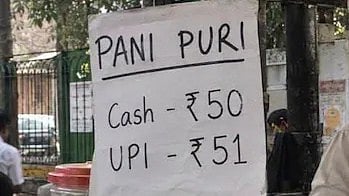
Some notices were hanging at shop entrances in Ghaziabad, Uttar Pradesh, over the past weekend.
‘UPI payments not accepted here’.
‘Pani puri: Cash - Rs. 50; UPI - 51’.
This was something expected once MDR was introduced.
What does MDR mean...
Merchant Discount Rate - This has been implemented across India by the central government from October 15.
Accordingly, for merchants receiving UPI payments of more than Rs. 1 lakh per month, 0.4 percent is deducted as a fee on each payment they receive.
According to the central government, this fee will not apply to payments below Rs. 2,000, merchants who receive less than Rs. 1 lakh in UPI payments per month, or transactions between two individuals.
MDR is not a tax or fee collected by the central government. It has been explained as a charge for banks and payment service providers that simplify UPI payments.
Most importantly, merchants and businesses should not collect this charge from customers. They themselves must pay it. The central government had also said that banks would monitor whether this is being done properly.
What is the problem?
As soon as this MDR was introduced, many objections arose that this charge would ultimately fall on customers.
But the central government insisted repeatedly that such a thing would not happen.
However, the shops in Ghaziabad have now shown India what will happen.
The notices that hung in Kasipath yesterday could spread across India today.
Many people who have received large sums into a single account and have not paid the proper income tax could get caught through this MDR. One could give 1008 reasons to prove that MDR is justified, saying that it ensures the correct fee reaches UPI service providers.
No merchant or business would be ready to accept this charge. As a result, cash transactions will increase again.
The steady Digital India that began gradually may now even disappear.
Will Digital India disappear?
As cash transactions increase, the very goal for which Digital India was introduced—eliminating black money, corruption, and bribery—may itself disappear.
Even if UPI payments are made beyond this, that charge will definitely be collected from the customers. Kasibath is a good example of this.
A merchant will always be a merchant when it comes to money... that is the only way they can be.
In such practices, the government will remain the government.
In changes implemented without proper procedure or action, it is the customers who end up being affected in the end.!