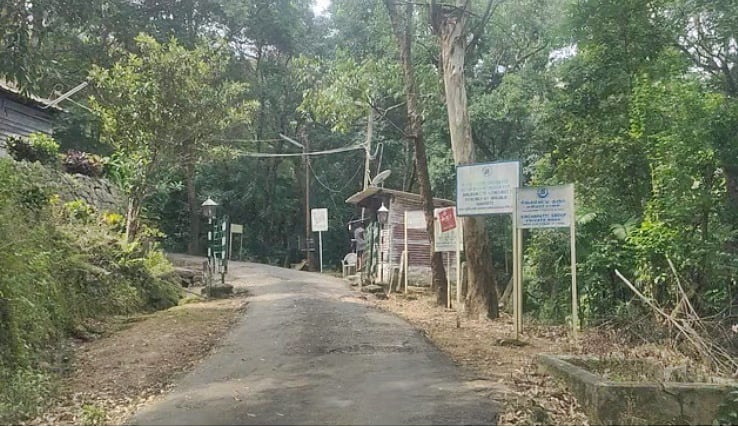
The Supreme Court on Tuesday adjourned, without specifying a date, the verdict in the case seeking the removal of encroachments in Manjolai, Megamalai, and the surrounding protected forest areas.
A petition filed by John Kennedy seeking alternative arrangements for the people living in the Manjolai area also came up for hearing in the Supreme Court. The bench comprising judges Vikram Nath and S.V.N. Bhatti heard the case.
During the hearing, the judges questioned why the Madurai–Kollam highway project was brought there even though it was known to be a protected forest area. They also said that if a road is built, shops, restaurants, and other establishments could come up, potentially harming wildlife, and added that building an elevated road like the one in Kaziranga National Park or modifying the project could be considered.
During the afternoon hearing, the judges said that the report filed by the Tamil Nadu government appeared to be in favor of the kapok plantations.
Senior advocate Jaideep Gupta, appearing for the Tamil Nadu government, said that many parts of Meghamalai were not forest areas earlier and were later declared reserve forest.
In response, the judges said that if an area is declared a forest, then it is a forest, and it has no other meaning. The judges also asked why the government is encouraging the establishment of silk cotton plantations in forest areas. They further said that there is no change in their stand that encroachments caused by silk cotton plantations must be removed.
In response, the Tamil Nadu government said that those who have established the silk-cotton plantations are the people living in that area, and that no one has come from outside to set up the plantations.
It was also stated by the Tamil Nadu government that no pattas have been issued recently, and that pattas were issued as far back as 1982. The government also said that if action is taken to remove the land of patta holders, there is a possibility of law and order problems.
At the same time, the Tamil Nadu government said that action is being taken to recover land from those who have occupied and held it without pattas, and that notices have already been issued to those without proper pattas and permission, with steps to evict them having begun.
Advocate Parameswar, appointed to assist the court in the case, said that Meghamalai was declared a reserve forest area as early as 1978.
Furthermore, he stated that many of those currently residing there are encroachers, and since the government itself encouraged the establishment of kapok plantations in Megamalai, the government also bears the responsibility of rehabilitating the plantation workers employed there.
The counsel assisting the court stated that if those who have established kapok plantations under the Forest Rights Act are allowed to claim land rights, it would set a wrong precedent.
In response, the Tamil Nadu government argued that the Forest Rights Act was enacted to protect the rights of the people, and how can it be said that people who have lived in that area for generations cannot claim rights under that law?
Following this, although people who genuinely live by depending on the forest should not be affected, the government itself had encouraged the establishment of silk-cotton plantations in the Meghamalai surrounding area, and only after that did large-scale encroachments occur; therefore, encroachers should not be allowed to claim land rights, the counsel assisting the court argued.
Subsequently, the judges stated that people who came from outside to establish silk-cotton plantations cannot be permitted to encroach upon the area in any manner.
Subsequently, the Supreme Court adjourned, without specifying a date, the verdict in the case concerning the removal of encroachments in Manjolai, Meghamalai, and the surrounding protected forest areas.