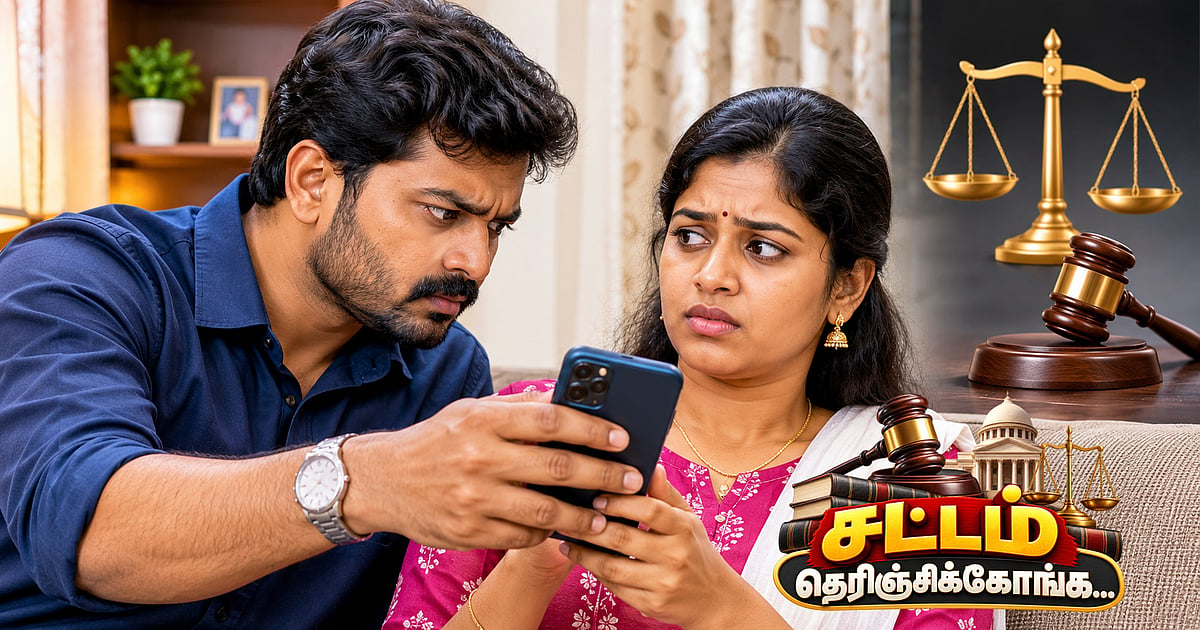
If your husband or wife suddenly says, “Let’s swap our phones. I’ll look at yours, and you look at mine,” would you hand over your phone without any hesitation?
Would giving it like that be a sign of true love and trust? Just because someone is a husband or wife, do they have the full right to check the other person’s phone?
It is one thing for a person to willingly give their mobile phone to someone else and allow them to use it; it is quite another to secretly view or download information without permission. These two situations are not treated the same under the law. If a person refuses to hand over their mobile phone, is that unlawful?
Does a person have a right to privacy even within a marital relationship? What does the law say about a husband or wife checking the other’s mobile phone without permission?
Let’s find out.
Even in marriage, there is privacy!
Marriage does not transfer all of one person’s personal rights to another. Privacy is also protected as part of the right to life recognized under Article 21 of the Indian Constitution.
This includes a cellphone as well. The relationship of husband or wife alone does not give the right to secretly view a person’s private messages, photographs, emails, call records, and so on without their permission.
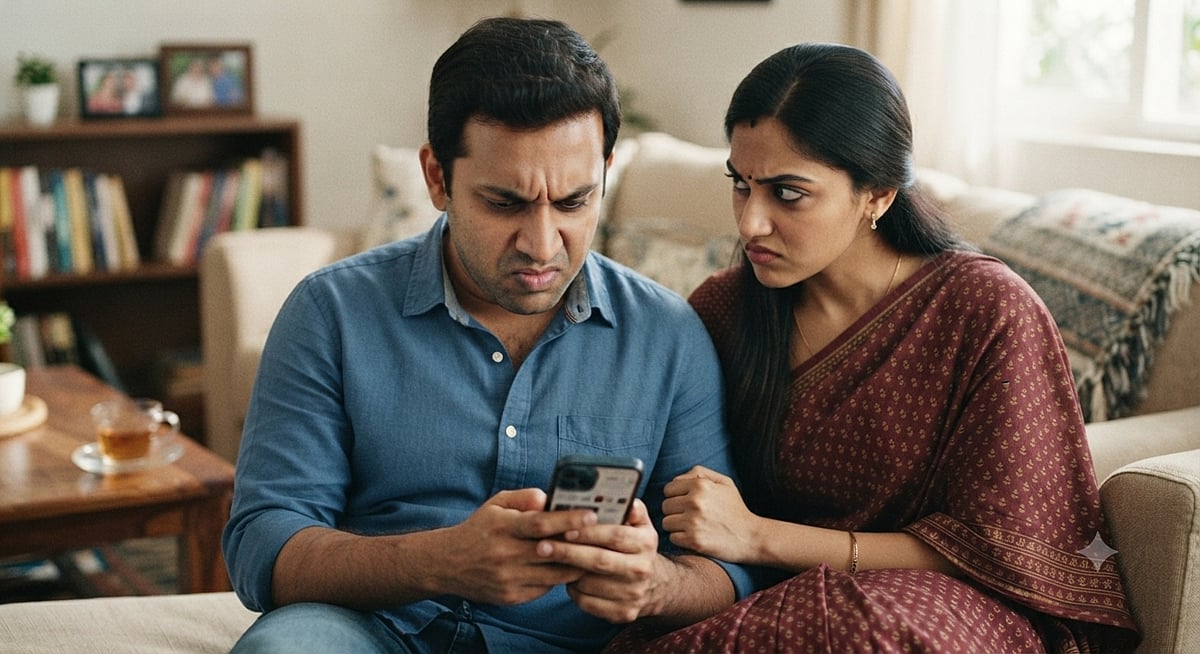
Moreover, a person’s refusal to hand over their cellphone to another person cannot by itself be regarded as wrongful conduct or as evidence of distrust in a marital relationship.
What does the court say?
In this regard, a case came up for hearing before the Madurai Bench of the Madras High Court in 2024. In a divorce case, while the wife’s cellphone and SIM card were in his possession for a short time, the husband used the OTP sent to that cellphone to download the wife’s call records through the telecom company Jio’s website and submitted them in court as evidence.
The judge who heard this case, G.R. Swaminathan, noted that the call records secretly obtained by the husband without the wife’s consent violated her privacy. He also pointed out that the certificate required to admit such electronic evidence had not been properly submitted. Stating that the right to privacy exists even within marriage, and that evidence obtained by violating privacy cannot be accepted, he set aside the lower court’s order.
What legal action can be taken?
Accessing information on a cellphone or computer, downloading data, or copying it without a person’s permission may, depending on the nature of the incident, fall under Section 43 of the Information Technology Act, 2000.
If such acts were committed with dishonest or fraudulent intent, criminal action may also be taken under Section 66. However, merely looking at a cellphone once without permission does not automatically amount to an offense under these sections; the conditions specified in the law must be satisfied.

Likewise, a man’s continued monitoring of a woman’s internet use, email, or other electronic communications may amount to the offense of “stalking” under Section 78 of the Bharatiya Nyaya Sanhita (BNS), 2023. This section specifically mentions monitoring electronic communications. However, merely looking at a cellphone or reading a message every time does not automatically amount to the offense of stalking; the decision must be made by considering the nature of the incident, the nature of the monitoring, and the exceptions provided in the law.
Are digital evidence valid in family courts?
In divorce or family welfare cases, it has become common for husbands and wives to submit WhatsApp chats, call records, or audio/videos against each other. However, courts do not readily accept electronic evidence that has not been obtained with the proper digital certificate under the Bharatiya Sakshya Adhiniyam, 2023, or Section 65B of the Information Technology Act, 2000. Moreover, evidence obtained through unlawful means (by spying or secretly stealing data) may be treated as a violation of the fundamental right to privacy and may also be rejected.

Trust is not surveillance!
There is nothing wrong with a husband and wife willingly sharing their mobile phones with each other. But forcing someone to check, secretly using OTPs, installing spy apps, or sharing personal information with others can lead to legal complications.
Even if someone has been given permission to use a cellphone, that does not mean they have unlimited permission to download all the personal information on it or share it with others. The scope of the permission and the nature of the information must be taken into account.
Trust and transparency are essential in a marital relationship. But that does not mean one person’s personal space and rights can be taken away. Love is not about monitoring someone; it is about respecting their privacy.