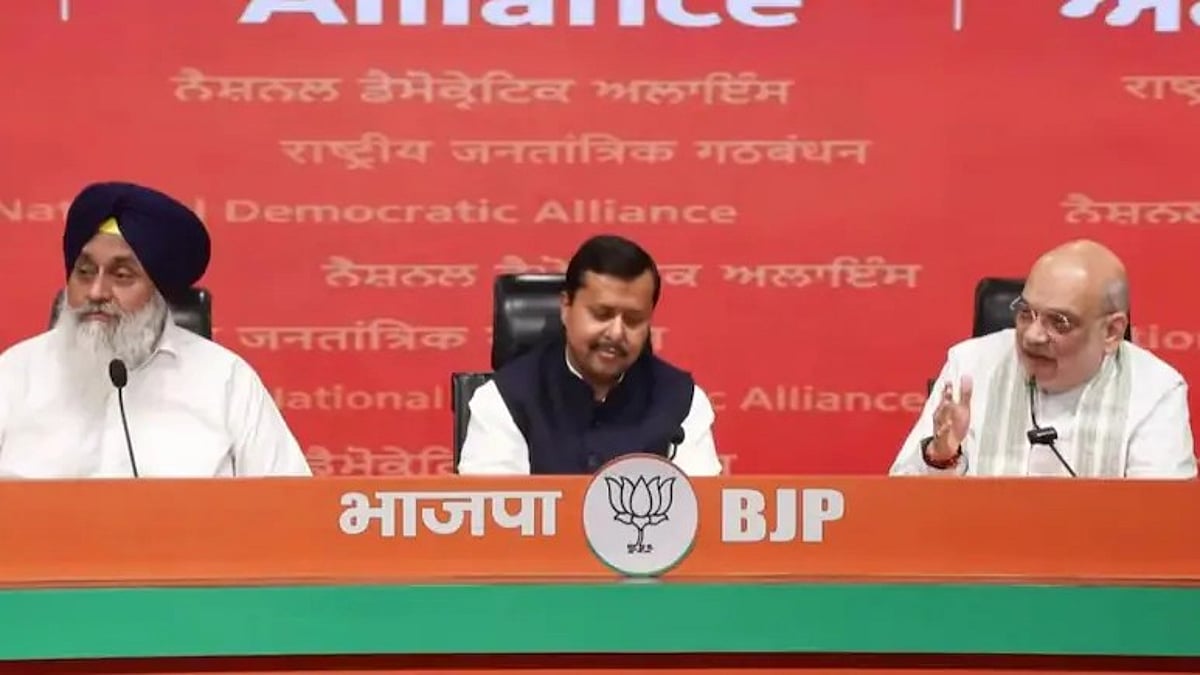
New Delhi: The BJP and the Shiromani Akali Dal have formed an alliance again in Punjab. This has raised the question of whether it will yield results in the Punjab Assembly election.
The BJP and the Akali Dal have joined hands for the Punjab Assembly election. Union Home Minister Amit Shah, BJP leader Nitin Naveen, and Akali Dal party chief Sukhbir Singh Badal announced this alliance today.
Nitin Naveen described this alliance as an example of “Hindu-Sikh brotherhood.” Pointing to the long-standing relationship with the Akali Dal, Amit Shah said he was pleased that the National Democratic Alliance’s oldest ally has rejoined.
Sukhbir Singh Badal shared his family ties with Prime Minister Narendra Modi and his experiences in Punjab. The alliance, which had broken down over differences regarding the farm laws, has now been renewed.
Since Punjab is home to 38 percent Hindus and 58 percent Sikhs, this alliance is also seen as a symbol of Hindu-Sikh brotherhood. The joining of these two parties is bringing about many changes in the political landscape.
Although leaders of both parties call this alliance a natural one, it is also regarded as a necessary alliance. This is because, in Punjab, neither party has achieved notable success since they split.
In the 2017 election, when the two parties contested together, the Akali Dal secured 25.42 percent of the votes and 15 MLAs. At the same time, the BJP won only 3 MLAs with 5.43 percent of the votes.
As a result, although the National Democratic Alliance (NDA) lost power in Punjab at the time, it retained a respectable position. Later, after the two split, the situation changed completely during the 2022 election.
The Shiromani Akali Dal contested in 97 constituencies in Punjab. But with 18.52 percent of the votes, it won only three MLAs. Although the Akali Dal received 28.61 lakh votes, those votes did not translate into electoral victory.
The BJP’s failure to secure Hindu votes in many constituencies became the reason for the alliance’s overall defeat. The favorable conditions the alliance had in both urban and rural areas slipped away.
It was clearly evident that the political climate had changed significantly between 2017 and 2022. Neither party wanted a similar situation to arise again in 2027.
Because the alliance broke apart, the vote shares of both parties declined. The Akali Dal, which had received 25 percent of the votes in 2017, was pushed into a position where it could secure only 18 percent of the votes in 2022. As a result, recognizing the necessity and urgency of the current situation, the two parties have reunited. To win a significant share of Sikh and Hindu votes, it has become essential for these two parties to come together.
In this alliance, the Akali Dal is the main party. The BJP remains its junior partner. Together, they are contesting all 117 constituencies. Reports indicate that the BJP will likely contest 39 constituencies, while the Shiromani Akali Dal will contest 78. For the first time in Punjab, the Aam Aadmi Party is in power.