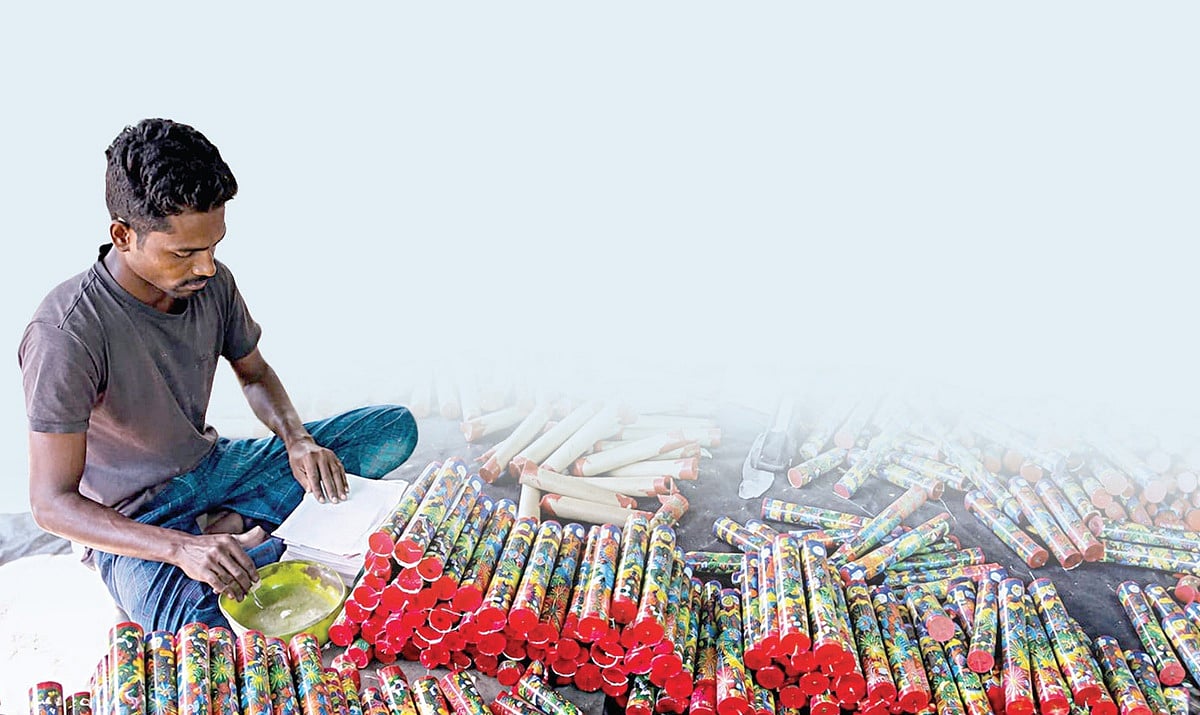
Sivakasi: Manufacturers are worried as the final-stage firecracker production work in the Sivakasi area has been affected due to drizzle and cloudy weather.
More than 1,100 firecracker factories are operating in the Sivakasi area. Of these, 75 percent are large-scale industries that produce all kinds of firecrackers, including fancy crackers, with permission from the Petroleum and Explosives Safety Organisation.
More than 90 percent of the country’s total demand is produced in the firecracker factories in the Sivakasi region. Here, firecrackers are produced throughout the year, centered around Diwali.
Since the use of barium nitrate to produce firecrackers and the Supreme Court’s ban on chain firecrackers have made it impossible to produce various types of firecrackers, large quantities of different kinds of firecrackers are being produced. These include chakra, puswanam, bijili bombs, kuruvi, Laxmi, bombs, stick sparklers, and fancy firecrackers that rise high into the sky and explode.
In it, sparklers and fancy fireworks are produced in various forms. Since drying is a very important task at every stage of firecracker production, temperature plays a major role. In the Sivakasi region, there is a suitable environment for firecracker production because most days of the year are dry, with high temperatures and no rain.
Due to the series of firecracker factory explosions and restrictions that occurred at the beginning of this year, firecracker production came to a standstill during the summer months of April, May, June, and July. For the past two months, firecracker production had been in full swing in the factories in the Sivakasi area. Meanwhile, over the past week in the Sivakasi region, the heat has decreased and a cool, cloudy atmosphere has prevailed. In addition, since a light drizzle fell in the Sivakasi surrounding areas yesterday afternoon, the final stage of firecracker production has been affected.
Regarding this, firecracker manufacturers said: Firecrackers must be dried at various stages for 4 to 7 days in both sunlight and shade. Since the weather has changed over the past week, they are afraid to dry them outside. If the firecrackers are not dried properly, they will not burst well. They said that production has already declined this year, and now that the rains have begun during the Diwali season, production will fall further.