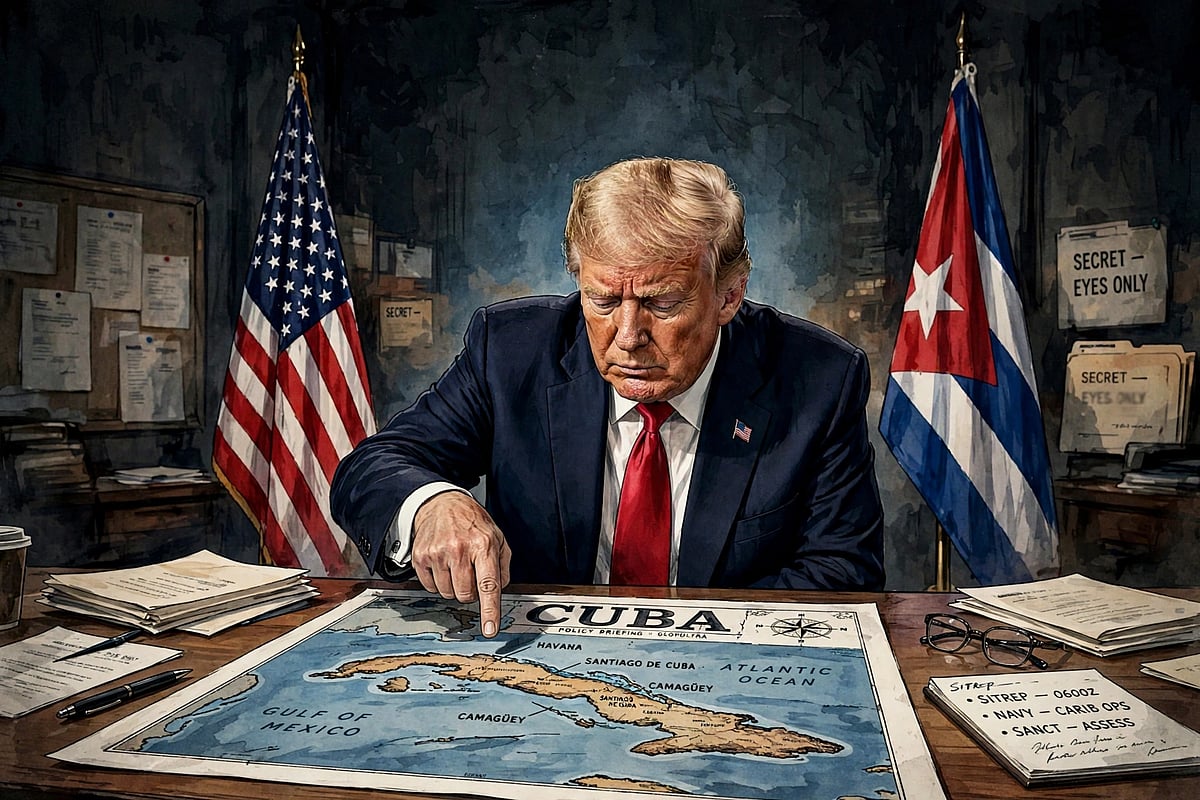
U.S. President Donald Trump’s threat to seize Cuba, which is located just 145 km from the United States, has created tension in international politics.
Cuba has no missiles of its own, no nuclear weapons, and no oil reserves large enough for export. With its economy completely crippled, it is facing power cuts of up to 20 hours a day. Compared with the U.S. military budget, Cuba’s is not even 0.1 percent. Even so, the United States has been trying to seize Cuba for about 66 years.
In 1959, Fidel Castro overthrew the U.S.-backed government of Fulgencio Batista through a revolution and seized power. Fidel Castro nationalized the American companies that had been dominating Cuba and turned it into a Soviet Union-backed country.
In 1962, the placement of Soviet nuclear missiles in Cuba, just 145 km (90 miles) from Florida in the United States, brought the world to the brink of the start of World War III. The United States, which imposed an economic embargo on Cuba then, has continued to expand those sanctions in stages and pressure the country to this day.
Trump shows aggression
While the United States had been imposing a severe economic crisis on Cuba, some easing was introduced during Barack Obama’s administration. Obama, who opened the U.S. embassy in Cuba in 2014, relaxed travel restrictions.
Later, Donald Trump, who took office as U.S. president in 2017, began tightening pressure again, vowing to bring down Cuba’s communist government. Americans were banned from traveling to Cuba for tourism, educational trips, and sending remittances. Trump also blocked international funds that could be made available to Cuba by adding the country to the list of nations that sponsor terrorism.
Trump, who has become U.S. president for a second time, has begun taking his next steps. Upon coming to power, the Trump administration issued two executive orders against Cuba and declared a national emergency against that country. He threatened to impose additional tariffs on countries that supply crude oil to Cuba.
Meanwhile, U.S. forces arrested Venezuelan President Maduro, whose country had been supplying crude oil for Cuba’s daily needs, last January. After that, the subsidized crude oil from that country also stopped reaching Cuba. In the past 10 months, only one Russian oil tanker has arrived in Cuba.
As a result, Cuba, which had relied on imported oil for 60 percent of its electricity needs, has fallen into a major energy crisis. Since May, when diesel reserves were completely exhausted, a 20-hour power outage has been announced for homes. Without electricity in hospitals, more than 100,000 people, including thousands of children, are waiting for surgery. Vaccines are spoiling because there is no power for refrigerated storage. The infant mortality rate, which was 4 percent in 2018, has risen to 9.9 percent in 2025.
In a situation where public transportation in the country has been severely disrupted, many schools and colleges have been closed. Classes for students are being held online for only limited hours.
Amid such crises, the Cuban government has announced an alternative plan. Speaking to reporters earlier this month, Cuba’s Energy Minister Vicente de la O Levy said, “With China’s help, we are installing 144 solar systems with a capacity of 1,418 megawatts. We will survive through solar power, wind power, and our own crude oil production.”
Threat to Cuba to Hold on to Florida
With the midterm elections set to take place in the United States on November 3, Trump has been causing tension by making controversial remarks during campaign events. Speaking at a campaign rally in Florida last Saturday, Trump once again claimed that he had stopped eight wars, including a India-U.S. war.
Similarly, he has controversially said that before the U.S. midterm elections, there could be a major attack on Iran, or a very important agreement could also be reached.
Meanwhile, in the 2024 election, 68 percent of the 1.5 million Cuban Americans living in Florida voted in support of Trump. Trump is campaigning in Florida, targeting their votes. During a campaign in Florida two days ago, Trump threatened, “On the way back from Iran, we will take care of Cuba. Then, we will send Marco Rubio to finish the deal.”
Adding weight to Trump’s threat, in an X post released by U.S. Secretary of State and Florida Senator Marco Rubio,
“This is the moment for those who want to create positive change in Cuba. Feel the frustration caused by unfulfilled promises, corruption, and the lavish lifestyles of a few. Secretly work with the C.I.A. and take advantage of this opportunity to create the change you want,” he has called out. (As far back as 1961, the U.S. C.I.A. suffered defeat in its attempt to wage war on Cuba using Cuban exiles. Fidel Castro’s government thwarted the American invasion in just 48 hours.)
To those who seek to create positive change in Cuba - now is the time.
— Secretary Marco Rubio (@SecRubio) October 23, 2026
The disappointment of failed promises, corruption, and the privileged lives of only a few; seize this opportunity to create the change you desire through a discrete partnership with the CIA.
For the United States, which keeps the world’s countries under its control, communist countries such as China, Russia, North Korea, Vietnam, and Cuba pose a major threat. In particular, America sees it as both a defeat and an ideological danger that communist rule has remained in place in Cuba, a country close to its own, for 66 years without yielding to any threats.
Is America threatening Cuba for the sake of the election? Or is it making moves to take over Cuba, just as it did with Venezuela? Whether Cuba will face this threat together with other communist countries will soon become clear.