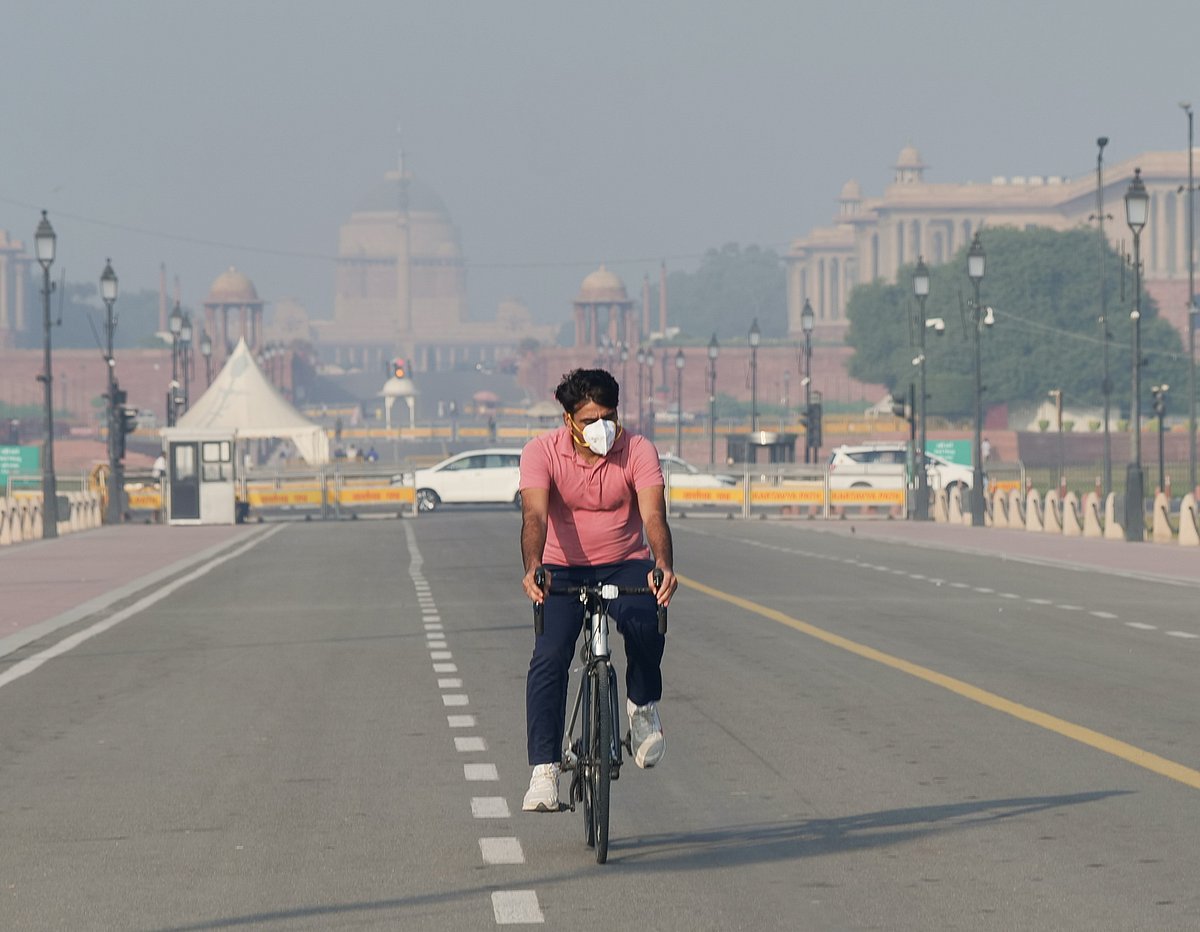
Delhi’s air quality improved slightly on Tuesday and entered the ‘poor’ category, with the air quality index settling at 299, data from the Central Pollution Control Board showed.
The city’s average air quality index improved from 344 on Monday to 299 on Tuesday. According to the Central Pollution Control Board, an air quality index of 0 to 50 is classified as ‘good’, 51 to 100 as ‘satisfactory’, 101 to 200 as ‘moderate’, 201 to 300 as ‘poor’, 301 to 400 as ‘very poor’, and 401 to 500 as ‘severe’.
Mahesh Palawat, vice president and meteorologist at Skymet, said, “The direction and speed of the wind have changed. At present, northwesterly winds are blowing across the Delhi region at an average speed of 12-14 km per hour, which has helped disperse the pollutants,” he said. Palawat further said that wind speeds are expected to remain high for the next few days, which could lead to further improvement in the air quality index.
Of the 58 monitoring stations that recorded data on Tuesday, air quality was in the ’very poor’ category at 28 stations, in the ’poor’ category at 28 stations, and in the ’moderate’ category at two stations. No monitoring station recorded air quality in the ’severe’ category.
Air quality monitoring stations in the Delhi Cantonment area and on Sri Aurobindo Marg recorded air quality in the ’moderate’ category. The average air quality index at those locations stood at 135 and 155, respectively.
According to the decision support system for Delhi, on Tuesday the transport sector was estimated to be the biggest contributor to the city’s pollution, at 18 percent.
Stubble burning accounted for 2 percent, and projections indicate that this contribution could rise to 7.9 percent on Wednesday.
Satellite data showed that 559 crop residue burning incidents were detected across six states on Monday.
Of these, 198 incidents were recorded in Punjab, 17 in Haryana, 47 in Uttar Pradesh, 50 in Rajasthan, eight in Uttarakhand, and 239 in Madhya Pradesh.
From September 15 to November 9, a total of 8,665 farm fire incidents were detected across these six states.
These data were provided in its press release by the laboratory of the Indian Agricultural Research Institute’s research consortium for space-based agro-ecological zone monitoring and modeling.