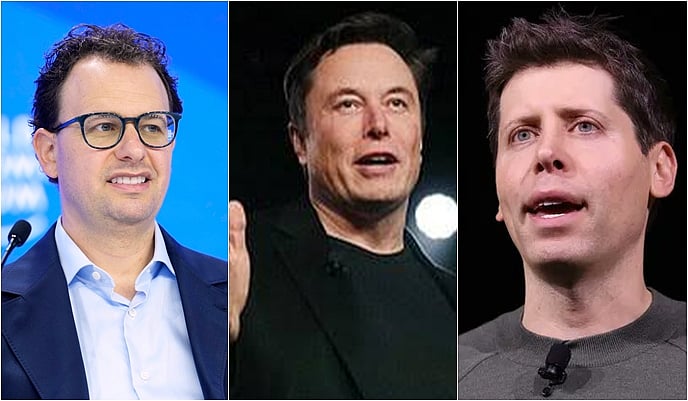
Anthropic CEO Dario Amodei has said that the growth of the artificial intelligence sector should be limited.
OpenAI chief Sam Altman and X chief Elon Musk, leaders of the world’s top AI companies, have said they welcome this view.
For the past few days, there have been intense discussions about the rapid growth of the artificial intelligence sector and the possible harms it could cause.
Against this backdrop, the leaders of the world’s leading AI companies themselves have expressed concern about the consequences of AI development.
Anthropic CEO Dario Amodei has written an article titled “We must exercise restraint in technological development.”
Regarding this, he posted on X:
“I have written an article about why the pace of the AI industry should be limited, and about a three-stage plan for doing so.
Anthropic has voluntarily stepped forward to carry out the first phase of these initiatives. For this purpose, we will grant third-party evaluators permanent, employee-like access to our systems so they can verify whether our safety procedures are being properly followed, report any lapses if they occur, and assess whether the models are behaving as intended during testing,” he said.
Some paragraphs from that article...
“I have been working in this field for the past twelve years because I believe that artificial intelligence has the power to improve the quality of human life. I have written many times about its tremendous benefits. I firmly believe that within the next 5 to 10 years, AI will be able to find solutions to most major diseases, greatly accelerate economic growth, create a world full of prosperity and empowerment, and bring about a revival of democracy and freedom. I have also felt its necessity personally. My father died of an illness. But a few years after his death, a cure for that illness was discovered. Likewise, I too have recovered from the early stages of cancer, which was incurable fifty years ago. If handled properly and carefully, AI will become an important milestone in the series of technological wonders that have improved and elevated humankind.”
But like many previous technologies, AI is also fraught with risks, and because it is such a powerful technology, its dangers are serious. These include the risk of AI losing control, the misuse of AI for cyberattacks and bioterrorism, and severe economic disruption.
Along with my co-founders and employees, I have been grappling with the duality of the risks and benefits of artificial intelligence. Not building the technology means losing out on benefits for humanity. At the same time, building it too quickly is irresponsible. We are looking for a middle path. We have tried to prioritize caution over speed and prudence over profit.
But over the past few months, I have become firmly convinced that even greater prudence is needed to fully address the risks. “We need to limit the pace at which we improve the capabilities of AI models,” Dario Amodei noted.
OpenAI CEO Sam Altman, who shared Dario Amodei’s post,
“I agree with Dario’s view that the pace of AI development should be limited. This has been the main topic of discussion in OpenAI recently.
Engaging independent evaluators with access equivalent to that of the company’s employees is a great idea; we will also follow that approach. We will share more information about this soon,” he said.
Similarly, X CEO Elon Musk posted that Dario’s view is correct.
Regarding artificial intelligence, Microsoft CEO Satya Nadella said that the development of AI should be in a way that helps humanity and remains under human control.
A few days earlier, technology expert Jacob Koxen, who had left Anthropic, had warned that the “superintelligence” being developed by AI companies poses the risk of humanity itself being destroyed by 2030.
At present, the leaders of the world’s leading artificial intelligence companies are debating the effects caused by AI, which has drawn international attention.