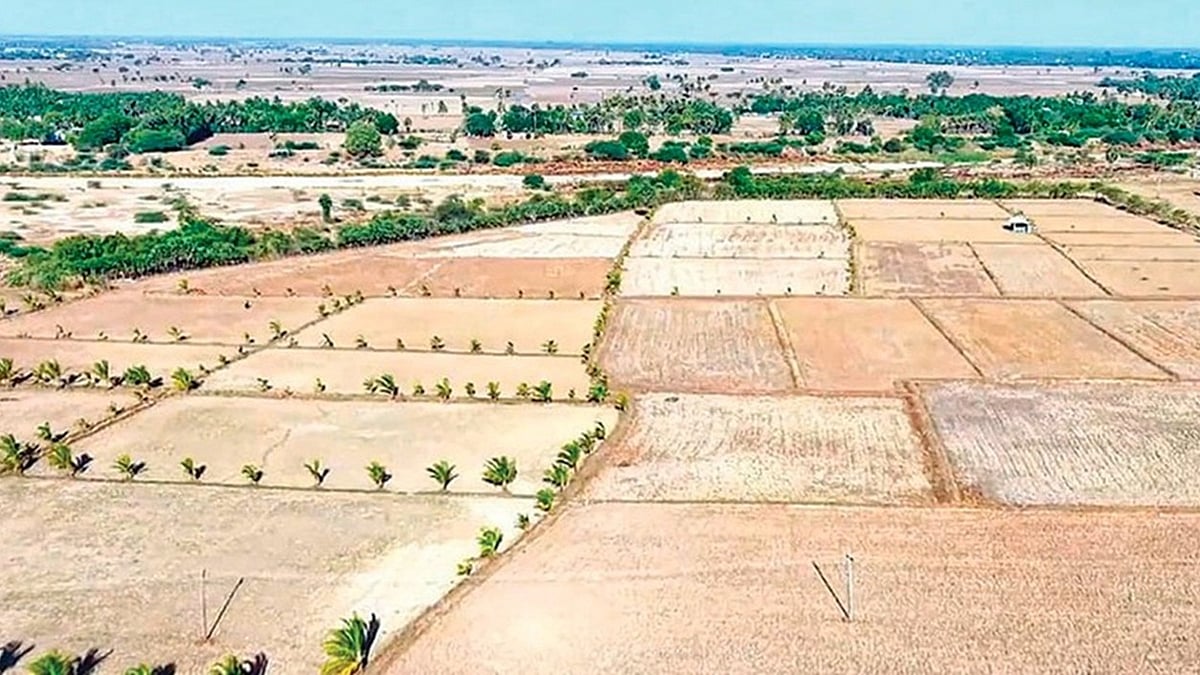
Nagapattinam: With kuruvai cultivation in the Cauvery delta having been completely affected, farmers are worried because there is not enough water for samba cultivation as well. As a result, farmers say there is a risk that paddy production in the delta will be severely affected this year.
In 2002, the southwest monsoon did not bring adequate rainfall, and Cauvery water was not available from Karnataka. The northeast monsoon also failed to help, so the delta faced severe drought. As a result, paddy production was badly affected. Due to poverty, incidents of people catching rats in the fields and eating them caused shock across Tamil Nadu at the time. There was also a situation where, unable to get fodder for livestock, people had to sell them for slaughter. Following this, relief measures such as free rice, the food-for-work scheme, and green fodder were provided.
In the current year, kuruvai cultivation has been carried out on only a few thousand acres in the delta, relying on pump-set irrigation. Following that, as the season for samba cultivation began, water was released from the Mettur dam for delta irrigation on Sept. 1. At that time, it was announced that water would be released from the dam for 45 days.
Water that did not reach the tail-end areas: Due to the delay in releasing water, many farmers abandoned the method of raising seedlings and transplanting them, and instead carried out direct paddy sowing. However, even a month after water was released from the dam, it has not fully reached the tail-end areas including Nagapattinam, Thiruvarur, and Mayiladuthurai, and as a result the crops have begun to wither, farmers say.
At this stage, the dam’s water level has fallen to 70 feet. Since water still needs to be released for delta irrigation for another 8 days, the water level is expected to drop below 60 feet. At the same time, the dam’s minimum water reserve, known as dead storage, is 32 feet. Even if the dam’s water level falls below 60 feet, water will still have to be released from the dam to meet drinking water needs.
Therefore, considering the available water, it appears unlikely that the water release for delta irrigation can be extended beyond the 15th of this month. Moreover, only if the northeast monsoon begins after that will it be possible to carry out samba cultivation to some extent. As a result, those who are waiting to sow as soon as water arrives, and those who have planned to begin samba cultivation using the broadcast method after ploughing, are unable to start their work and are struggling.
After Oct. 15?: Regarding this, Tamilselvan, the policy propaganda secretary of the Tamil Nadu Farmers Protection Association, said: “Normally, samba cultivation is carried out on 12 lakh acres in the delta. But due to the current water shortage, the prospects for this year’s samba cultivation are doubtful. Water has not reached not only the tail-end Thirumarugal area in Nagapattinam district, but even the areas below the Kallanai in Thanjavur district.”
In many places in Nagapattinam and Tiruvarur districts, crops have withered, and farmers have carried out direct sowing for the second time. With the government stating that water will be released for only 45 days, and with no chance of water being released after the 15th of this month, he said he did not know how samba cultivation could be carried out.
Debt burden... the next fear:
P.R. Pandian, general secretary of the Tamil Nadu Cauvery Farmers Association, said: Since there has not been a complete loan waiver already, farmers who are struggling under debt have now borrowed from moneylenders and carried out samba cultivation.
If this too fails, there is a risk that their livelihoods will deteriorate further. Therefore, he said the Delta should be declared a drought-affected area, and appropriate relief should be provided to farmers and agricultural workers.
The expectation of the Delta people is that the Tamil Nadu government should immediately take constructive measures to protect farmers, agricultural workers, and livestock so that a situation like the famine and starvation of 2002 does not recur.