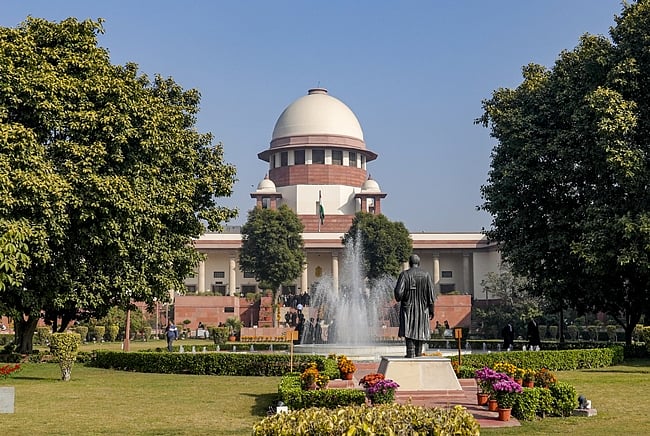
“The 24-hour deadline for producing an arrested person before a judge begins from the moment the police take that person into custody, and not from the time of formal arrest,” the Supreme Court ruled on Thursday.
The Supreme Court also ordered that “a person who is kept in custody for more than the permitted 24 hours without being produced before a judge must be released immediately.”
The Supreme Court delivered this ruling while hearing a petition challenging the Tripura High Court’s refusal to grant bail to four people arrested under various provisions of the Narcotic Drugs law.
The police took these four people into custody at 2.30 p.m. on September 29 last year, but recorded that they were formally arrested only at around 11.15 a.m. the next day, September 30. On that day, they were produced before a judicial magistrate at 4.45 p.m. and remanded to prison. The police did not account for the 18 hours during which they had taken them into custody and interrogated them. Pointing this out, the High Court rejected the bail petitions filed by the four of them. Challenging this, they appealed to the Supreme Court.
In the judgment delivered by the bench of Supreme Court judges Ujjal Bhuyan and Atul S. Chandurkar, which heard this petition on Thursday, it was stated:
According to Article 22(2) of the Constitution, every person who is arrested and detained must be produced before the nearest judicial magistrate within 24 hours, excluding the time taken to travel from the place of arrest to the court.
While calculating this 24-hour deadline, the orders issued by the Odisha High Court in the Aryaman Patnaik case, the Chennai High Court in the Kannan case, and the Kerala High Court in the Arun K. Thomas case, which permitted exclusion of the period spent in custody prior to formal arrest, are rejected.
There can be no artificial distinction between preventive detention and arrest. Any interpretation that allows the police to exclude the period of preventive detention before arrest is unconstitutional. In other words, the view that the 24-hour time limit begins only after a formal arrest is contrary to Article 22(2) of the Constitution and Section 56 of the Bharatiya Nyaya Sanhita (BNSS).
Therefore, judicial magistrates must independently examine and record the actual date and time of detention. Magistrates must also assess whether the period of detention is reasonable in the circumstances. In this regard, if the period of detention is excessive, judicial custody for that person may be denied.
They also ruled that a person held in preventive detention without being produced before a judicial magistrate beyond the permitted 24 hours must be released immediately.