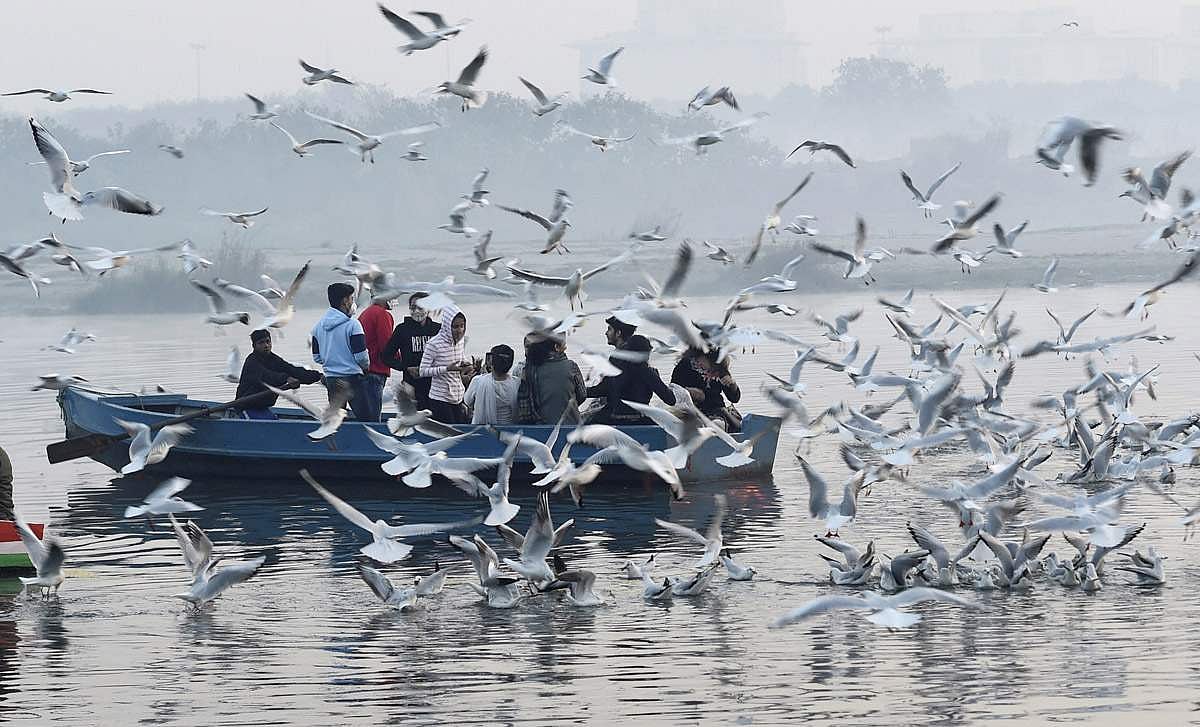
Sixty percent of the Yamuna river has been cleaned, its water has now become fit for drinking, and the entire river will be cleaned by 2029 or 2030, Delhi Environment Minister Manjinder Singh Sirsa said on Monday.
Speaking at a car company event in Delhi, the minister said that pollution caused by vehicles is a collective responsibility, and that even electric vehicles cause pollution because their tires generate dust while they run.
Sirsa praised Delhi Chief Minister Rekha Gupta and the central government for their support over the past two years in cleaning up the Yamuna River. He said that the work began at one end of the river and would be extended to the other end, which is why only 60 percent of the work has been completed rather than the entire length.
“Sixty percent of the Yamuna River is completely clean. By clean, I mean it should be clean enough to drink the water,” he said, and urged people to come to the river and see for themselves.
Sirsa said that the city’s sewage flows into the Yamuna through drains, and that a clean river is impossible unless that sewage is treated. She also said that the government is using sewage treatment plants to address this problem.
In an order dated November 4, a bench comprising Justices Manoj Misra and Manmohan noted that industrial pollutants and untreated sewage must be stopped at the source where they are generated, and that simply building more sewage treatment plants is not enough to clean the river.
This court considers that all the failures in civic administration in the cities, towns, and villages situated along the riverbanks are reflected in the poor condition of the river and in the 520 drains discharging sewage into the Yamuna.
‘This is why, despite huge sums being spent to clean the river, pollution in the Yamuna has increased,’ the bench said while hearing a petition related to cleaning the river.
Speaking about the city’s garbage, Sirsa said that with the support of the central government, 60 percent of the legacy waste accumulated over the past 25 years has been removed in less than two years. “The coming generations will see garbage heaps only in pictures, not in real life,” he said.
Speaking about air pollution, the minister said that this is not the responsibility of an individual and that clean air cannot be ensured by the government alone, and called for public participation.
“There is nothing more important than health.” “There is nothing more important than clean air,” he said.
Sirsa said that there has been improvement in the city this year, and that compared with previous years, more days were clean in the first half of October and November. Citing a New York Times article, he said that in 2012 the air quality index in the area around Delhi University was recorded at 900.
Meanwhile, Delhi Aam Aadmi Party chief Saurabh Bharadwaj on Monday questioned Environment Minister Manjinder Singh Sirsa’s claim that 60 percent of the Yamuna river has been cleaned. He also alleged that the 2030 deadline for cleaning the river has been set only to avoid accountability before the next Delhi Assembly election.
Bharadwaj said that if 60 percent of the river can be cleaned in 18 months, then the remaining 40 percent should be cleaned in the next 12 months.