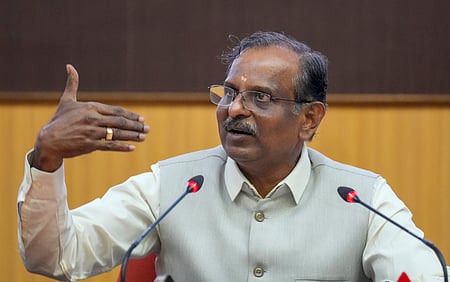
ISRO Chairman V. Narayanan said that in the current financial year (2026-2027), six missions are planned to be carried out: two PSLVs, one GSLV, an SSLV, G1, and one private launch.
The NVS-03 (IRNSS 1L) satellite, designed by ISRO, was successfully launched last Friday from the launch pad in Sriharikota aboard the GSLV F-18 rocket.
Following this, ISRO Chairman V. Narayanan told reporters:
The NVS-03 satellite has been precisely placed in the planned orbit. This is a highly significant achievement. There are currently 3 navigation satellites in orbit. This will be the 4th to join that group. At least 4 satellites in orbit are needed to provide location, navigation, and timing services through NavIC technology. Therefore, with this satellite launch, we have fully restored our NavIC services.
A navigation infrastructure is very essential for the country’s security. Through this, more than 10,400 train engines and 64,000 fishing boats are being monitored in real time. We have set a target to increase the number of fishing boats to 100,000 within the next 6 months. In addition, more than 5 million devices have been installed so far to track vehicles.
Last time, there was a technical issue related to the pyro valves during the NVS-02 satellite launch. This time, we decided to launch by keeping all 3 pyro valves open and relying only on the solenoid valves. Data from the 37 space missions conducted earlier confirmed that the “solenoid valves” operate without leakage.
Moreover, this decision was made only after vibration and shock tests. The satellite’s thrusters have now begun operating. All systems are functioning well.
In the current financial year (2026-2027), we plan to carry out 6 missions: two PSLVs, one GSLV, an SSLV, G1, and one private launch. Subsequently, the NVS-04 and NVS-05 satellites will be launched at intervals of 5 months each. A replacement satellite for NVS 02 will also be launched.
Under the Gaganyaan project, more than 8,000 tests have been completed so far. Before sending humans into space, 3 uncrewed space missions will be undertaken. Work on the first uncrewed mission is currently under way.
The NavIC system was designed to provide navigation services for India and areas up to 1,500 km around it. The initial goal is to complete a constellation of 7 satellites. Later, the possibility of expanding it into a global service will be studied. He said that the 7-satellite constellation must be completed in order to use the NavIC service on mobile phones.