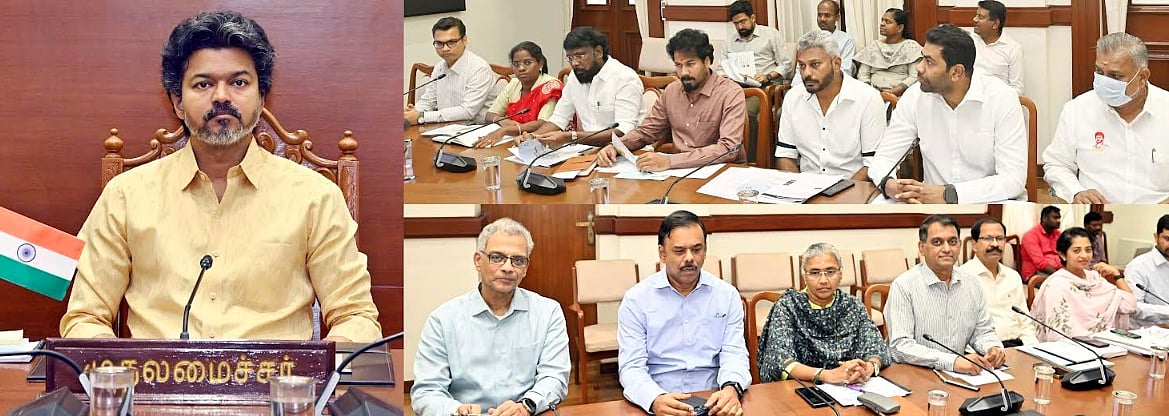
In areas where crop damage has exceeded 33 percent, Chief Minister Vijay has ordered that crop damage assessment work be started immediately and appropriate relief be provided.
In a statement issued by Chief Minister Vijay regarding this, a high-level review meeting was held today (27.11.2026) at the Secretariat under the chairmanship of Chief Minister S. Joseph Vijay on the status of the northeast monsoon in Tamil Nadu and the preparatory measures being taken to ensure drinking water and cattle feed requirements in the agriculture, horticulture, and livestock sectors during the upcoming summer. In the meeting, a detailed review was conducted of the state's rainfall situation, water storage in dams and lakes, groundwater levels, and the cultivated area of agricultural and horticultural crops.
Although rainfall in the state from June 2026 to November 25 was 20 percent below normal, below-normal rainfall has been recorded in only 22 districts. The water storage in dams in the catchment areas stands at 32.9 percent of their total capacity, and in nearly 73 percent of the lakes under the control of the Water Resources Department, water storage is at 50 percent or less.
Compared with the same period last year, the area under cultivation for agricultural crops has decreased by 18.4 percent. It was also pointed out at the meeting that crops have been affected in many districts due to reduced rainfall, and that there is a need to plan in advance to meet drinking water and livestock fodder requirements during the upcoming summer season.
In this situation, after a detailed review, the Chief Minister has taken the following key decisions.
1. Appropriate relief for crop losses
In areas where crop damage has exceeded 33 percent, crop damage assessment work will be started immediately, and steps will be taken to quickly provide relief assistance to eligible farmers in accordance with the relevant rules.
2. Special camp to enroll all eligible farmers in the crop insurance scheme
To ensure that all eligible farmers benefit from the crop insurance scheme, special camps and intensive awareness drives will be conducted across the state. The Chief Minister has directed District Collectors and Agriculture Department officials to monitor this daily and take steps to ensure that no eligible farmer is left out of the crop insurance scheme. In particular, they have been instructed to ensure that all eligible farmers register for the insurance scheme within the stipulated deadline.
3. Ministers and senior officials to visit the affected districts in person and inspect
A team comprising ministers and senior government officials has been instructed to visit the districts where rainfall has been recorded as low, inspect the conditions there in person, identify the damage caused to crops, the needs of farmers, and essential requirements including local drinking water, submit a detailed report, and take appropriate action.
In addition, district monitoring officers have been instructed to visit the districts assigned to them in person, thoroughly assess the conditions there, and submit a report to the government with recommendations on the measures that need to be taken.
4. District Collectors instructed to continuously monitor the situation and take action
The Chief Minister has directed that District Collectors must continuously and closely monitor the situation regarding monsoon impacts, crop damage, and farmers’ needs, and must immediately take appropriate measures to reduce the damage and provide the necessary assistance to farmers.
5. Comprehensive plan to ensure summer drinking water needs
A comprehensive action plan will be prepared to ensure uninterrupted drinking water supply throughout the state during the summer of 2027. For this purpose, the relevant departments, including the Municipal Administration and Rural Development Department, in coordination with the Water Resources Department, have been instructed to assess drinking water requirements district-wise and local body-wise, and to make advance arrangements including the necessary water sources, supply arrangements, and alternative arrangements.
6. Special schemes for livestock feed security
The Chief Minister has approved the implementation of various special schemes to ensure an adequate supply of fodder for livestock in the coming summer season.
Accordingly, measures will be taken to expand fodder crop cultivation on farmers’ lands and livestock department farms, improve grazing lands, establish community fodder banks through women’s self-help groups, set up integrated fodder storage facilities and silage production units, procure and store maize silage and hay, and provide livestock feed at subsidized prices. An allocation of Rs. 13 crore and 26 lakh has been made from the State Disaster Relief Fund for fodder production enhancement and livestock feed subsidy. The Animal Husbandry Department, in coordination with Aavin and related organizations, will take steps to ensure adequate fodder stocks during the period from February to June 2027, especially in districts where fodder shortages are likely to occur.
The Chief Minister has emphasized that the government will focus fully on identifying in advance the impacts caused by reduced rainfall and taking preventive measures, providing appropriate relief to affected farmers, ensuring farmers’ protection through crop insurance, safeguarding livestock, and ensuring summer drinking water and fodder needs across the state.
All District Collectors have been instructed to continue monitoring the situation, coordinate with the relevant departments, and take appropriate action, and the monitoring officers have been directed to report to the government on the status of their districts and the measures taken. The Chief Minister has also ordered all departments to implement the decisions taken at this meeting without delay.